Chemistry · Ch 2 — Solutions
Raoult's Law
Raoult's Law
Raoult's law states that the partial vapour pressure of any volatile component of a solution is equal to the vapour pressure of the pure component multiplied by its mole fraction in the solution.
Suppose that for a binary solution of two volatile liquids and , and are their partial vapour pressures and and are their mole fractions in solution. Then according to Raoult's law we write
where and are the vapour pressures of the pure liquids and , respectively.
According to Dalton's law of partial pressures, the total pressure above the solution is
Since , Eq. (2.2) can also be written as
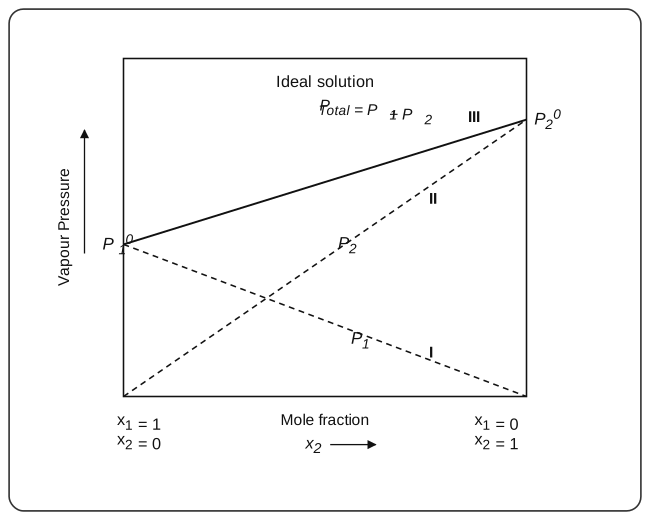
Because and are constants, a plot of versus is a straight line, as shown in Fig. 2.2. The figure also shows the plots of versus and versus according to equations (2.2): these are straight lines passing through the origin.
i. For versus (straight line), at and at .
ii. For versus (straight line), at and at .
iii. For versus (straight line), at and at .
Drawn by us to help you understand the concept clearly, and verified to make sure it's accurate. For exams, practice from your textbook's own diagram.
What this figure shows. Vapour pressure (y-axis) against mole fraction (x-axis, from at the left edge to at the right). The dashed line I () falls from at the left to zero at the right; the dashed line II () rises from zero at the left to at the right; the solid line III is the total pressure , running from to . For an ideal solution the t …
…