Chemistry · Ch 2 — Solutions
Raoult's Law for Solutions of Nonvolatile Solutes
Raoult's Law for Solutions of Nonvolatile Solutes
We saw in section 2.5.1 that Raoult's law expresses the quantitative relationship between the vapour pressure of a solution and the vapour pressure of the solvent. In solutions of nonvolatile solutes, the law is applicable only to the volatile solvent. The law states that the vapour pressure of the solvent over the solution is equal to the vapour pressure of the pure solvent multiplied by its mole fraction in the solution. Thus,
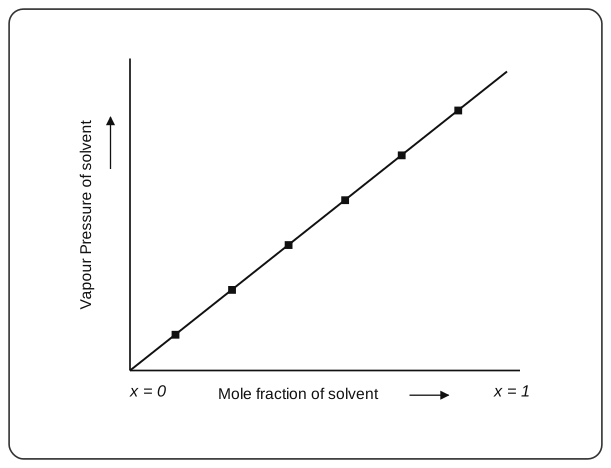
A plot of versus is a straight line, as shown in Fig. 2.5.
Drawn by us to help you understand the concept clearly, and verified to make sure it's accurate. For exams, practice from your textbook's own diagram.
What this figure shows. The vapour pressure of the solvent (y-axis) plotted against the mole fraction of solvent (x-axis, from to ). The plot is a single straight line through the origin, with small square data-point markers along it, illustrating : the solvent's vapour pressure above the solution scales linearly with its own m …
For a binary solution containing one solute, . It therefore follows that
Eq. (2.5) defines as , the lowering of vapour pressure. Hence
…