Mathematics · Ch 5 — Vectors
Direction Angles and Direction Cosines
Direction Angles and Direction Cosines
For a non-zero vector , its direction angles are the angles it
makes with the positive axes, and their cosines are its
direction cosines (d.c.'s). Since is the angle between and , , and similarly . Squaring and adding these three,
and , so are exactly the components of the unit
vector along . The axes' own direction cosines are , and a line has direction cosines in one sense and in the other (the
two directions along the same line).
Direction ratios. Any three numbers proportional to the direction cosines ( for some ) are called direction ratios (d.r.'s). Since forces
, the direction cosines are recovered from direction ratios by
(matching signs throughout). A line has infinitely many direction-ratio triples (any scalar multiple works)
but only one unsigned set of direction cosines.
Worked examples.
- Direction ratios give magnitude , so direction cosines .
- A line perpendicular to two given lines (with direction ratios and ): writing the unknown direction cosines , the two perpendicularity conditions and give two linear equations, solved together (and then normalised by ) for the direction ratios/cosines of the perpendicular line.
- For a line making equations and : eliminate using the first (linear) relation, substitute into the second (quadratic) relation to get a homogeneous quadratic in alone, factor it to …
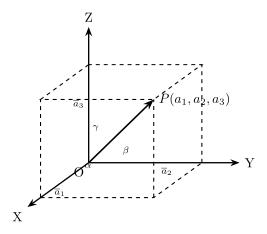
Drawn by us to help you understand the concept clearly, and verified to make sure it's accurate. For exams, practice from your textbook's own diagram.
What this figure shows. Shows a vector a drawn from the origin together with the three angles it makes against the positive X, Y and Z axes, labelled alpha, beta and gamma; dropping these three angles down to their cosines (cos alpha, cos beta, cos gamma) gives exactly the direction cosines l, m, n used everywhere afterwards to describe a line's orientation in space, including in the perpendicularity and angle-between-lines problems of the exercises. …