Mathematics · Ch 5 — Vectors
Section Formula
Section Formula
Theorem 5 (Section formula, internal division). Let and be two points and
a point on segment dividing it internally in the ratio (so -- in order and
). Then
Proof idea: since and point the same way along the line,
in magnitude and direction; writing and
and substituting gives , which rearranges
to , i.e. the formula above. Componentwise, if , then for .
Theorem 6 (Section formula, external division). If divides externally in the ratio
(so lies on line but outside the segment), then
The proof mirrors the internal case, using for the external
configuration.
Special cases. Writing the ratio as is often convenient:
(internal) or (external). Taking (i.e. ) in the internal
formula gives the Midpoint Formula: .
Centroid formulas. In , the centroid divides each median internally in the
ratio and is given by . In a tetrahedron , the centroid
divides the segment from each vertex to the centroid of the opposite face in the ratio , and
.
Worked examples.
- Dividing internally in the ratio : gives the point ; dividing externally in the same ratio gives , the point .
- If are collinear with dividing in the ratio , then ; matching each coordinate gives three equations, and solving the -equation first for (since it involves no unknowns besides ) lets the other two equations be solved for in turn. A negative value of found this way means actually divides externally rather than internally.
- If are position vectors of a triangle's vertices and , isolating matches the external-division form with ratio , showing divides externally in the ratio .
- Concurrency of medians (by vectors). With the midpoints of of , the midpoint formula gives etc.; combining (each equal to ) and dividing by 3 shows the point lies on each of , dividing each in the ratio -- so the three medians are concurrent at the centroid.
- Concurrency of angle bisectors (incenter). Using the section formula on each angle bisector (dividing the opposite side in the ratio of the two adjacent sides) and combining the three resulting expressions shows they all meet at , the incenter formula, e.g. giving for the triangle .
- Standard extra centre formulas noted for reference: centroid ; incenter as above; orthocenter .
- Given centroid coordinates for a triangle or tetrahedron with some unknown vertex coordinates, the centroid formula is solved coordinate-by-coordinate for the unknowns (e.g. finding from a stated centroid of triangle equal to ). …
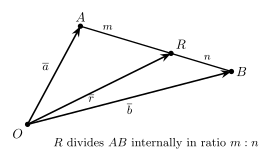
Drawn by us to help you understand the concept clearly, and verified to make sure it's accurate. For exams, practice from your textbook's own diagram.
What this figure shows. Draws the segment AB with a point R marked strictly between A and B, with the two sub-segments AR and RB labelled m and n respectively to show the ratio in which R splits the whole segment; a small triangle from an external point O (used as the origin for position vectors) to A, B and R is also sketched to set up the vector proof, since the internal-division formula is derived precisely by comparing the vectors OA, OB and OR through thi …