Mathematics · Ch 5 — Vectors
Projections
Projections
Let and share initial point , and let be the
foot of the perpendicular from to the line containing (so , with , is that
foot). Then:
- Scalar projection of on is -- described in the text as the "shadow" casts on the line of if the sun were directly overhead (i.e. shining perpendicular to ). Likewise the scalar projection of on is .
- Vector projection of on is that scalar length carried in the direction of :
Symmetrically, the vector projection of on is .
These formulas are the standard tool for finding the foot of a perpendicular from a point onto a line (project
the vector to the point onto the line's direction vector and add back the starting point) and for splitting a …
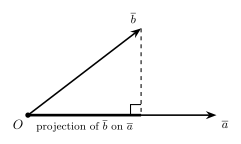
Drawn by us to help you understand the concept clearly, and verified to make sure it's accurate. For exams, practice from your textbook's own diagram.
What this figure shows. Draws two vectors a and b from a common point P, drops a perpendicular from the tip of b onto the line containing a, and marks the foot of that perpendicular as S; the length PS is the scalar projection of b on a, described in the text as the shadow b would cast on the line of a if a light shone directly overhead (perpendicular to a). The picture is what makes the formula (a.b)/|a| intuitive rather than just algebraic: it is literally reading off how far along a's direction the vector b …