Mathematics · Ch 5 — Vectors
Representation of Vector
Representation of Vector
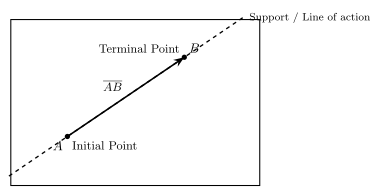
A vector is drawn as a directed line segment: if and are two points and the segment carries
an arrowhead at , the resulting directed segment represents the vector (read "AB
bar" or "vector AB"), with called the initial point and the terminal point.
Drawn by us to help you understand the concept clearly, and verified to make sure it's accurate. For exams, practice from your textbook's own diagram.
What this figure shows. Shows a segment AB drawn with an arrowhead at B. The arrow marks the sense of travel from the initial point A to the terminal point B, so the same segment read the other way (from B to A) is a different vector, written BA, with the opposite direction but the same length. The figure is the visual anchor for calling A the initial (or tail) point and B the terminal (or head/tip) point, and for the idea that the full unbounded line through A and B is called the line of support (or line of action) of the vector, while the vecto …
Reading the same
segment the other way gives the vector , which has the same length but the opposite
sense. The full (unbounded) straight line through and is called the vector's line of support or
line of action. When the initial and terminal points of a vector are not specified, it is written using a
single lower-case letter with a bar or arrow, e.g. .
Example (identifying vectors from a diagram). Given a picture of several arrows of assorted lengths and directions, one can read off directly from the picture: which are equal in magnitude (same length, direction irrelevant), which are parallel (same or exactly opposite direction),
which point in the same direction, which pairs are equal vectors (same length AND same direction), and …