To describe how a plane is tilted (rather than just a line, as slope does), two vectors lying in the plane
are combined to produce a third vector perpendicular to that plane -- this is the vector (cross) product.
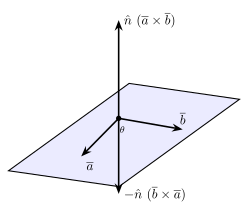
Definition. For non-collinear, non-zero vectors aˉ,bˉ, choose the unit vector n^
perpendicular to the plane of aˉ,bˉ by the right-hand rule: curl the right-hand fingers from
aˉ towards bˉ through the angle θ between them, and the thumb then points along n^.
Then
aˉ×bˉ=∣aˉ∣∣bˉ∣sinθn^.
Remarks.
∣aˉ×bˉ∣=∣aˉ∣∣bˉ∣sinθ (since ∣n^∣=1).
aˉ×bˉ is perpendicular to the plane of aˉ and bˉ.
The unit vector along aˉ×bˉ is n^=(aˉ×bˉ)/∣aˉ×bˉ∣.
If aˉ,bˉ are coplanar but non-collinear, any vector cˉ in space can be written
cˉ=xaˉ+ybˉ+z(aˉ×bˉ), since aˉ,bˉ,aˉ×bˉ together span the
whole of space.
bˉ×aˉ=−(aˉ×bˉ) (anti-commutative): reversing the order reverses the sense of
the right-hand curl, flipping n^ to −n^.
aˉ×bˉ=0ˉ exactly when aˉ,bˉ are collinear (either is zero, or
sinθ=0); in particular aˉ×aˉ=0ˉ always, and if aˉ=kbˉ then aˉ×bˉ=0ˉ.
Distributive laws: aˉ×(bˉ+cˉ)=aˉ×bˉ+aˉ×cˉ and
(bˉ+cˉ)×aˉ=bˉ×aˉ+cˉ×aˉ.
For scalars m,n: (maˉ)×bˉ=m(aˉ×bˉ)=aˉ×(mbˉ) and
(maˉ)×(nbˉ)=mn(aˉ×bˉ).
^×^=^×^=k^×k^=0ˉ, and, since
^,^,k^ form a right-handed triplet, ^×^=k^,^×k^=^,k^×^=^.
Component formula. For aˉ=a1^+a2^+a3k^,bˉ=b1^+b2^+b3k^,
aˉ×bˉ=^a1b1^a2b2k^a3b3.
Angle from the cross product. Since ∣aˉ×bˉ∣=∣aˉ∣∣bˉ∣sinθ,
sinθ=∣aˉ×bˉ∣/(∣aˉ∣∣bˉ∣), giving a second route (besides the dot product) to the
angle between two vectors -- useful particularly when a right angle or the vectors' sine is more natural than
their cosine.
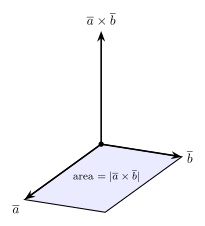
Geometric meaning (area). If aˉ,bˉ share an initial point, they determine a parallelogram of
base ∣aˉ∣ and height ∣bˉ∣sinθ, so its area is ∣aˉ∣⋅∣bˉ∣sinθ=∣aˉ×bˉ∣.
Worked examples.
For aˉ=^+^−k^,bˉ=2^+4^+6k^: expanding the determinant
gives aˉ×bˉ=10^−8^+2k^, and dotting this with aˉ and with bˉ separately both give 0, confirming it is orthogonal to both.
To find all vectors of a given magnitude perpendicular to the plane of two given vectors: compute
aˉ×bˉ, find its magnitude, form the unit vector n^=(aˉ×bˉ)/∣aˉ×bˉ∣, and scale ±n^ by the required magnitude.
If uˉ+vˉ+wˉ=0ˉ, crossing this equation with vˉ (and separately noting
vˉ×vˉ=0ˉ) gives uˉ×vˉ=−wˉ×vˉ=vˉ×wˉ; a similar
manipulation shows vˉ×wˉ=wˉ×uˉ too, so all three pairwise cross products are
equal.
Showing aˉ×(bˉ×cˉ)=(aˉ×bˉ)×cˉ in general: compute both sides
numerically for specific vectors and observe they differ, confirming the cross product is not
associative.
Area of a triangle with vertices A,B,C: form AB,AC, take
AB×AC and halve it.
Area of a parallelogram KLMN: form two adjacent side vectors from one vertex and take the magnitude of
their cross product directly (no halving).
∣uˉ×vˉ∣=∣uˉ∣∣vˉ∣sinθ is evaluated directly once ∣uˉ∣,∣vˉ∣,θ are
all known or read off a sketch.
Distributive law verification: for specific aˉ,bˉ,cˉ, compute aˉ×(bˉ+cˉ) and aˉ×bˉ+aˉ×cˉ separately and check they agree, term by term.
Showing three points with given position vectors are collinear: compute AB and
AC and show AB×AC=0ˉ (rather than checking
one is a scalar multiple of the other component-by-component); since 0ˉ cross product means the two
vectors are collinear, and A is shared, A,B,C are collinear.
Finding a unit vector perpendicular to two given vectors PQ,PR, and the
sine of the angle between them: form the cross product, divide by its magnitude for the unit vector, and use
sinθ=∣PQ×PR∣/(∣PQ∣∣PR∣) for
the sine.
Given ∣aˉ∣,∣bˉ∣,∣aˉ×bˉ∣, first solve ∣aˉ×bˉ∣=∣aˉ∣∣bˉ∣sinθ …
Figure 1Fig. 5.51 — Right-hand rule for ā × b̄: the unit normal n̂ = ā × b̄ points out of the plane of ā and b̄ (−n̂ = b̄ × ā)
ⓘDrawn by us to help you understand the concept clearly, and verified to make sure it's accurate. For exams, practice from your textbook's own diagram.
What this figure shows. Shows a right hand curling its fingers from vector a towards vector b through the angle between them, with the thumb standing straight up to point along a x b, which sits perpendicular to the plane containing both a and b. The same picture also shows that curling the fingers the other way, from b towards a, flips the thumb to point along -(a x b) = b x a, which is the geometric reason the cross product is anti-commutative rather than commutative like …
Figure 2ā × b̄ is perpendicular to the plane of ā and b̄, and |ā × b̄| equals the area of the parallelogram with sides ā and b̄
ⓘDrawn by us to help you understand the concept clearly, and verified to make sure it's accurate. For exams, practice from your textbook's own diagram.
What this figure shows. Draws a parallelogram with adjacent sides a and b starting from a common point, marks the perpendicular height of the parallelogram as |b|sin(theta), and notes that base times height gives exactly |a||b|sin(theta), which is the magnitude of a x b. This is the geometric payoff of the cross product used repeatedly in the exercises: the area of a parallelogram (or, halved, of a triangle) built on two given vectors is simply the magnitude of their cross product, with no …