Physics · Ch 14 — Dual Nature of Radiation and Matter
Davisson and Germer Experiment
Davisson and Germer Experiment
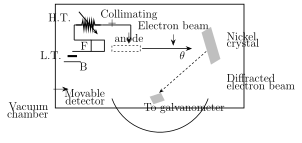
The Davisson-Germer experiment, performed in 1927 (with an independent confirmation by G. P. Thomson in 1928 using a different method), provided the first direct experimental proof of de Broglie's matter-wave hypothesis. The whole apparatus sits inside an evacuated chamber. An ELECTRON GUN produces a stream of electrons by heating a tungsten filament F using a battery B (thermionic emission); these electrons are then accelerated through vacuum to a chosen speed by a suitable accelerating potential applied across a cylindrical anode, and collimated into a narrow, focused beam.
This electron beam is directed onto a NICKEL CRYSTAL, where it is scattered in various directions by the regularly spaced atoms of the crystal lattice -- so in this experiment, electrons play the role that light waves play in an ordinary diffraction experiment. The scattered electrons are picked up by a movable ELECTRON DETECTOR, whose current is measured with a galvanometer; by swinging this detector around a graduated circular scale, the experimenters could measure the scattered electron intensity as a function of the scattering angle (the angle between the incident and scattered beam directions), for a chosen accelerating potential.
If electrons behaved purely as classical particles, the scattered intensity should vary smoothly and monotonically with angle. Instead, Davisson and Germer found the intensity pattern was NOT uniform at all -- it showed sharp PEAKS and TROUGHS as a function of angle, exactly resembling a diffraction pattern: peaks where scattered waves from different atomic layers interfered constructively, and troughs where they interfered destructively. Since diffraction is a property unique to waves, this directly demonstrated that the electrons themselves were behaving as waves on scattering from the crystal -- confirming that particles can show wave-like properties, exactly as de Broglie had proposed.
Quantitatively, varying the accelerating potential from 44 V to 68 V, they found the sharpest such peak at a scattering angle of 50° for an accelerating potential of 54 V -- the signature of constructive interference between electrons scattered from successive, regularly-spaced atomic layers in the nickel crystal. Using de Broglie's own formula, Eq. (14.7), the predicted wavelength for a 54 V electron is
…
Drawn by us to help you understand the concept clearly, and verified to make sure it's accurate. For exams, practice from your textbook's own diagram.
What this figure shows. An evacuated chamber containing, on one side, an electron gun assembly: a heated tungsten filament F (heated by a separate battery B, acting as the source of thermionic electrons) placed inside a cylindrical anode held at a variable accelerating potential, which accelerates and collimates the emitted electrons into a narrow, focused beam. This electron beam travels across the evacuated chamber and strikes a nickel crystal target, where it is scattered in various directions by the regularly-spaced atoms of the crystal. On the far side, a movable electron detector -- mounted so it can be swung around a graduated circular scale to sit at any chosen scattering angle (the angle between the incident beam direction and the direction to the detector) -- collects the scattered electrons, and the resulting current is measured by a galvanometer connected to the detector. The whole geometry (filament → accelerating anode → collimated beam → nickel crystal → angle-adjustable detector → galvanometer) is what lets the experimenters map …