Physics · Ch 14 — Dual Nature of Radiation and Matter
The Photoelectric Effect
The Photoelectric Effect
In 1887, Heinrich Hertz was experimenting with the production of electromagnetic waves using a spark discharge when he noticed something unrelated to his main investigation: when ultraviolet light fell on one of his metal electrodes, a high-voltage spark passed across the gap more easily. It was later understood that this happened because electrons were being knocked out of the metal surface by the incident light.
This phenomenon -- the emission of electrons from a metal surface when radiation of a sufficiently high frequency falls on it -- is called the PHOTOELECTRIC EFFECT, and a surface that emits electrons this way, when illuminated appropriately, is called a photosensitive surface. Different metals need different kinds of light: metals like zinc, cadmium and magnesium need ultraviolet radiation, while the alkali metals (like potassium and sodium) show the effect even with ordinary visible light, because their electrons are more loosely bound. …
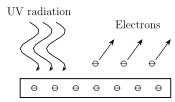
Drawn by us to help you understand the concept clearly, and verified to make sure it's accurate. For exams, practice from your textbook's own diagram.
What this figure shows. A schematic showing a beam of incident electromagnetic radiation (drawn as wavy arrows or rays, labelled with its frequency) striking the flat surface of a metal plate from outside. On impact, one or more electrons are shown being knocked out of the metal surface, drawn as small particle symbols with outward-pointing arrows (their emission direction), leaving the bulk of the metal plate otherwise intact. The figure's purpose is simply to establish the basic picture of the effect being defined in this section: radiation of suitable frequency goes in, free 'photoelectrons' come out of the illuminated metal surface -- no voltages, circuit elements …