Physics · Ch 14 — Dual Nature of Radiation and Matter
Photo Cell
Photo Cell
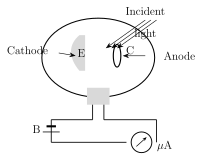
The PHOTOCELL is a practical device that puts the photoelectric effect to direct use, converting incident light energy into an electrical (current) signal. Its construction differs slightly from the flat-plate laboratory set-up of Fig. 14.2: inside an evacuated glass or quartz bulb sits a semi-cylindrical photosensitive metal plate E, acting as the cathode, together with a wire LOOP collector C acting as the anode, positioned roughly along the axis of the semi-cylinder. (In some designs, the photosensitive coating is instead applied as a thin film directly on the inner wall of the glass bulb, rather than as a separate curved plate.) The electrodes connect to an external circuit containing a high-tension battery B (supplying the accelerating potential) and a sensitive microammeter to register the resulting current.
When light of a wavelength the cathode material responds to falls on E, photoelectrons are emitted and drawn across the gap to the anode C by the applied electric field; the resulting photocurrent, read off the microammeter, directly reflects whether (and, within limits, how much) light is falling on the device. …
Drawn by us to help you understand the concept clearly, and verified to make sure it's accurate. For exams, practice from your textbook's own diagram.
What this figure shows. An evacuated glass (or quartz) bulb containing two electrodes: a semi-cylindrical (curved, concave) photosensitive metal plate E acting as the cathode, positioned so its concave face looks inward across the bulb, and a straight wire loop C (a simple loop of wire, not a flat plate) mounted roughly along the axis of the semi-cylinder, acting as the anode/collector. Outside the bulb, E and C are wired in series to a high-tension battery B (supplying the accelerating potential) and a microammeter μA that registers the photocurrent. When light of suitable wavelength enters the bulb and strikes the concave cathode surface E, the emitted photoelectrons are drawn across the gap to the central wire-loop anode C by the applied field, and the resulting current is read off the microammeter -- the figure's semi-cylindrical-cathode-around-a-central-wire-loop geometry i …