Physics · Ch 11 — Magnetic Materials
Magnetic Moment of an Electron Revolving Around the Nucleus of an Atom
Magnetic Moment of an Electron Revolving Around the Nucleus of an Atom
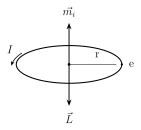
Model an electron of charge moving with constant speed v in a circular orbit of radius r about the nucleus (Fig. 11.4). If the electron completes one full revolution (circumference ) in time T, its orbital speed is , and the associated (conventional) current is , where is the orbital angular speed.
Treating this orbit as a current loop of area , its magnetic dipole moment -- called the orbital magnetic moment -- is . The electron's orbital angular momentum is (where is the electron's mass), so eliminating between the two expressions gives -- the orbital magnetic moment is directly proportional to the orbital angular momentum. Because the electron's charge is negative, however, the current direction associated with its orbit is OPPOSITE to its actual direction of travel, so the vector points opposite to : . The constant of proportionality, , is called the gyromagnetic ratio, and its value for an electron, C kg, is computed in Example 11.2.
Bohr's model of the hydrogen atom postulates that orbital angular momentum is quantised in integer multiples of : for . Substituting into gives ; for the smallest orbit, , this defines a fundamental unit of atomic magnetic moment called the Bohr magneton, A m, in terms of which the magnetic moments of atoms are conventionally expressed (as in the table of effective magneton numbers for iron-group ions).
Orbital motion is not the only source of an electron's magnetic moment: an electron also possesses an intrinsic spin angular momentum, quite apart from any orbital motion, and this spin gives rise to its own spin magnetic dipole moment, again pointing opposite to the spin angular momentum because of the electron's negative charge. The total magnetic moment of an atom is the vector sum of the orbital and spin contributions of all its electrons. …
Drawn by us to help you understand the concept clearly, and verified to make sure it's accurate. For exams, practice from your textbook's own diagram.
What this figure shows. A single electron is drawn moving with constant speed v along a circular orbit of radius r about a central, positively charged nucleus. The orbital motion is indicated with an arrow showing the direction of travel around the circle; because the electron is negatively charged, the conventional current direction associated with this orbit (used to compute the orbital magnetic moment as a current loop, ) is opposite to the electron's actual direction of travel, which is the figure's key visual point feeding directly into the derivation of and its direction relativ …
Worked out. Given the electron's charge C and mass kg, the gyromagnetic ratio (the constant of proportionality between the orbital magnetic moment and orbital angular momentum, ) is computed directly as C kg, a universal constant for the electron independent of its particular orbit, confirming that the relation derived in the section holds with a fixed proportionali …
Ion | Electron configuration | Effective magnetic moment (Bohr magnetons, experimental)
Fe | 3d | 5.9
Fe | 3d | 5.4
Co | 3d | 4.8
Ni | 3d | 3.2
(Values determined experimentally from magnetic susceptibility measurements; several of these ions' moments arise from a combination of both orbital and spin angular momentum contributions, not orbital motion alone. …
Worked out. By the Pauli exclusion principle, no two electrons in an atom can share the same set of all four quantum numbers (); consequently, electrons that pair up in the same orbital (same , opposite spin) have their spin magnetic moments cancel exactly, so only atoms/molecules with an ODD number of electrons in their OUTERMOST orbit possess a nonzero resultant magnetic dipole moment (completely filled inner orbits never contribute). A 3-step method is given to check any atom: (1) write its full electronic configuration, (2) ignore the completely filled inner orbitals and draw only the valence-shell orbital diagram, (3) count any unpaired electrons in that diagram. Worked for chlorine (17 electrons): configuration ; ignoring the filled inner shells, the valence orbital is fully paired but the valence orbitals hold 5 electrons where only 4 can pair up, leaving exactly one unpaired electron -- so chlorine has a nonzero net atomic magnetic moment. The reader is invited to repeat the same 3-step method for Fe, Zn, He, …