Physics · Ch 10 — Magnetic Fields due to Electric Current
Introduction
Introduction
Class XI's study of magnetism began with the bar magnet as a given object -- something with a fixed North and South pole whose field could be measured and drawn. This chapter turns that story on its head: instead of taking a magnet as the starting point, it asks where magnetic fields actually come from, and the answer, discovered experimentally by Hans Christian Oersted, is electric currents. Oersted found that a compass needle held near a current-carrying wire deflects to align itself with the magnetic field the current produces -- the first direct evidence that electricity and magnetism are not two separate phenomena but two faces of the same underlying physics. This discovery was built on over the following decades by Gauss, Henry, Faraday and others, and eventually unified mathematically in Maxwell's theory of electromagnetism, which showed that electric and magnetic fields are intimately linked and, together, are responsible for an enormous range of everyday technology: electric motors, generators, communication systems, and the magnetic storage and processing at the heart of computers.
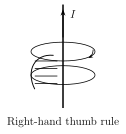
Up to this point (in electrostatics), the discussion was restricted to STATIC charges and the forces they exert on other static (or test) charges. This chapter's whole subject is what happens once those charges start MOVING -- specifically, moving in an organised, directed way, as an electric current. Two threads run through the whole chapter: (1) a moving charge (or a current, which is many moving charges together) experiences a force when it sits in an external magnetic field -- studied first, in Sections 10.2 through 10.9; and (2) a moving charge (or current) also PRODUCES its own magnetic field -- studied second, in Sections 10.10 onward, via the Biot-Savart law and Ampere's law. Both threads trace back to the same simple qualitative fact, already met in Class X: hold a magnetic compass needle near a current-carrying wire, and it swings to show the direction of the magnetic field curling around that wire. Grab the wire (mentally) with your right hand, thumb pointing along the direction of the current, and your curled fingers show the direction this field circles in -- the right-hand thumb rule that recurs throughout the whole chapter.
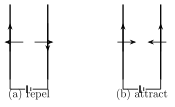
This is not merely an abstract classroom fact. High-tension power transmission lines -- the ones carried on tall steel towers across the countryside -- carry very large currents and, as a direct consequence of everything this chapter develops, produce correspondingly strong magnetic fields around themselves; safety guidelines require exposure levels near such lines to be kept below about 0.5 milligauss. The chapter opens with a simple, striking demonstration of the NEW kind of force at work here: two flexible conducting wires, hung side by side and connected to a cell, are found to swing apart (repel) when connected so that current flows in opposite directions along them, and to swing together (attract) when connected so that current flows in the same direction along both. Crucially, this force cannot be an electrostatic one -- the wires, taken as a whole, remain electrically neutral throughout (the same number of electrons enter as leave, at every instant), so there is no net charge for Coulomb's law to act on. Some genuinely new force, arising specifically from the MOTION of charge, must be responsible -- and identifying, then quantifying, that force (the magnetic force) is exactly where Section 10.2 begins.
Drawn by us to help you understand the concept clearly, and verified to make sure it's accurate. For exams, practice from your textbook's own diagram.
What this figure shows. Two flexible conducting wires are hung side by side from an insulating support and connected to a cell via binding posts, first in one configuration (a) and then in the other (b). In (a), the wires are connected so that conventional current flows in OPPOSITE directions along the two wires (anti-parallel currents) -- as soon as the circuit is closed, the wires visibly swing apart, i.e. they REPEL each other. In (b), the connections are rearranged so that current flows in the SAME direction along both wires (parallel currents) -- the wires visibly swing together, i.e. they ATTRACT each other. The figure's purpose is purely to establish this qualitative fact by direct demonstration, before any formula is derived: the force is not of electrostatic origin (both wires are overall neutral), so some new, non-electrostatic force must be at work between currents.
10.1a-b: Fig. 10.1 (a) and (b): Two current-carrying wires, repelling and attracting.
Drawn by us to help you understand the concept clearly, and verified to make sure it's accurate. For exams, practice from your textbook's own diagram.
What this figure shows. A single straight current-carrying wire is shown with a right hand loosely wrapped around it, thumb extended and pointing along the wire in the direction of the conventional current flow. The curled fingers of that same hand trace circular arcs AROUND the wire, illustrating that the magnetic field lines produced by the current form closed circles concentric with the wire, lying in planes perpendicular to it, and that the SENSE in which those circles are traced (the direction the fingers curl) is the direction of the magnetic field at each point around the wire -- the basic qualitative rule (already met in Xth Std.) that the rest of the chapter makes quantitative.
10.2: Fig. 10.2: Right hand thumb rule.