Physics · Ch 1 — Rotational Dynamics
Moment of Inertia of a Uniform Ring
Moment of Inertia of a Uniform Ring
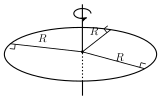
Drawn by us to help you understand the concept clearly, and verified to make sure it's accurate. For exams, practice from your textbook's own diagram.
What this figure shows. A thin circular ring of mass M and radius R, drawn as a simple circle (a one-dimensional loop with negligible thickness), rotating about an axis passing through its centre, perpendicular to the plane of the ring (shown as a line or dot-and-cross symbol through the centre). A small representative arc/element of the ring's mass is marked on the circumference, with a radial line of length R drawn from the centre out to that element, emphasising that EVERY point of the ring's mass lies at the same fixed distance R from the axis -- the key geometric fa …
A uniform ring is an object whose mass is spread (practically) uniformly around the circumference of a circle -- a two-dimensional object of negligible thickness, like a bangle or a thin metal hoop. When such a ring of mass M and radius R rotates about its OWN axis (the line through its centre, perpendicular to its plane), every single particle making up the ring's mass lies at EXACTLY the same distance R from that axis -- there is no spread of distances to integrate over at all. The sum then collapses trivially, since every is the same constant: So the moment of inertia of a uniform ring of mass M and radi …