Physics · Ch 1 — Rotational Dynamics
Moment of Inertia of a Uniform Disc
Moment of Inertia of a Uniform Disc
A disc is a two-dimensional, effectively flat, circular object (negligible thickness), said to be UNIFORM if its composition and its mass per unit area are the same everywhere across its surface -- this constant ratio (mass over area) is called the surface density. Unlike a ring, a disc's mass is spread over a whole RANGE of distances from the axis (from practically zero at the centre out to R at the rim), so finding its moment of inertia genuinely requires an integration.
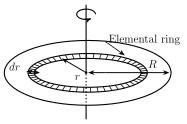
Drawn by us to help you understand the concept clearly, and verified to make sure it's accurate. For exams, practice from your textbook's own diagram.
What this figure shows. A uniform circular disc of mass M and radius R, shown rotating about an axis through its centre, perpendicular to its plane. Within the disc, one thin CONCENTRIC RING of radius r (measured from the centre, with ) and small width dr is highlighted/shaded, representing a representative mass element used in the integration; its own radial extent dr is marked as noticeably thin (much smaller than R), and its area is understood as the circumference times the width dr, i.e. a thin annular strip -- this is the elemental ring whose moment of inertia is integrated from r = 0 (the disc's centre) o …
The trick is to imagine the disc built up out of many thin CONCENTRIC RINGS, each of some radius r (with ) and infinitesimally small width dr -- so small that every particle within that one ring can be treated as being at the same distance r (exactly as in section 1.5.1). The area of this thin ring is (circumference)(width) , so its mass is . Being effectively a ring of mass dm and radius r, its own moment of inertia (about the same central axis) is, from section 1.5.1's result, The whole disc's moment of inertia is then obtained by summing (integrating) these ring contributions from r = 0 (the very centre) out to r = R (the rim): Substituting back : So a uniform disc's moment of inertia about its own central axis is -- exactly HALF that of a ring of the same mass and radius, which makes sense physically: the disc's mass is spread all the way from the centre out to R (much of it close to the axis, contributing little to I), whereas the ring's ENTIRE mass sits right out at the maximum distance R. …