Physics · Ch 1 — Rotational Dynamics
Point Mass Undergoing Vertical Circular Motion Under Gravity
Point Mass Undergoing Vertical Circular Motion Under Gravity
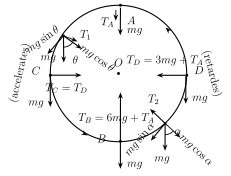
Consider a bob (a point mass) tied to a practically massless, inextensible, flexible string, whirled so that it performs a full vertical circular motion of radius r (the string length), the string rotating in a vertical plane, with the entire motion powered by gravity alone after an initial push. At any general position of the bob, exactly two forces act on it: its weight mg (constant, always vertically downward) and the string tension (variable in magnitude, always directed along the string, towards the centre). Because the motion is non-uniform (the speed changes continuously as the bob rises and falls), the resultant of these two forces is directed exactly towards the centre ONLY at the very top and the very bottom of the circle; everywhere else part of the resultant is TANGENTIAL, changing the bob's speed rather than just redirecting it.
Drawn by us to help you understand the concept clearly, and verified to make sure it's accurate. For exams, practice from your textbook's own diagram.
What this figure shows. A vertical circle of radius r (the length of the string) traced by a bob, with four key positions marked: A at the very TOP (uppermost point), B at the very BOTTOM (lowermost point, diametrically opposite A), and C and D at the two points where the string is exactly HORIZONTAL (on either side of the circle, level with the centre). At A, both the weight mg and the string tension point straight down (both towards the centre, which lies below A). At B, the weight mg points down while the tension points straight up (towards the centre, which lies above B), the two forces opposing each other. At C and D, the tension acts horizontally along the string (towards the centre) while the weight mg acts straight down, i.e. TANGENTIAL to the circle at those …
**Uppermost point (A):** both mg and the tension point straight down, i.e. both towards the centre (which lies below A), so together they supply the full centripetal force: Since a string can only PULL (never push), can never become negative -- if it did, the string would simply go slack instead. The smallest possible speed at A, obtained by setting (the borderline case, using the least possible energy), is therefore
**Lowermost point (B):** the tension now points straight up (towards the centre, which lies above B) while mg still points down, opposing it, so Coming down from A to B, the bob falls through a vertical height of 2r under gravity alone, so by energy conservation Substituting the minimum value from Eq. (1.10) gives the corresponding minimum speed at the bottom,
**Extreme tension difference:** subtracting Eq. (1.9) from Eq. (1.11) and using Eq. (1.12) to eliminate the speeds gives This is a genuinely striking result: the DIFFERENCE between the two extreme tensions depends ONLY on the weight mg of the bob -- not on the radius, not on the actual speed at either point, not even on whether the bob is moving at the bare minimum allowed speed or considerably faster. Any valid vertical circular motion under gravity, whatever its actual energy, obeys exactly. …