Physics · Ch 1 — Rotational Dynamics
Vehicle at the Top of a Convex Over-Bridge
Vehicle at the Top of a Convex Over-Bridge
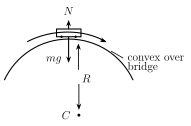
Drawn by us to help you understand the concept clearly, and verified to make sure it's accurate. For exams, practice from your textbook's own diagram.
What this figure shows. A vertical cross-section of a convex (arched/hump-shaped) over-bridge of radius of curvature r, with a vehicle shown as a small block exactly at the TOPMOST point of the arch, at the instant it crosses the crest. Two force arrows act on the vehicle, both drawn along the same vertical line: weight mg pointing straight DOWN (towards the centre of curvature of the arch, which lies below the road at this topmost point) and normal reaction N pointing straight UP (away from the road surface, opposing gravity). Their difference is the net downward (centripetal) force that keeps the vehicle following the curved …
A vehicle crossing the crest of a convex (arched, hump-shaped) over-bridge is, for a brief instant, undergoing a small piece of vertical circular motion, with the bridge's radius of curvature r playing the role of the circle's radius. At the very TOPMOST point of the arch, exactly two forces act on the vehicle, both along the same vertical line: weight mg, downward, and the normal reaction N from the road, upward. Since this topmost point is the highest point of the (locally circular) path, the centre of curvature lies BELOW the road at that point, so the net downward force -- weight minus normal reaction -- must supply the centripetal force: As the vehicle's speed v increases, the required centripetal force increases, and since mg is fixed, N must correspondingly DECREASE to make up the difference. Since the normal reaction is precisely the physical indicator of contact between the vehicle and the road, the vehicle stays on the road only as long as ; the borderline case (just losing contact) sets the upper speed limit Driving faster than this over the crest of the bridge means the vehicle would need a downward force greater than its own weight to stay on the curved path -- since the road ca …