Physics · Ch 6 — Superposition of Waves
Vibrations of air column in a pipe closed at one end
Vibrations of air column in a pipe closed at one end
Consider a long cylindrical tube, closed at one end, with a vibrating tuning fork held near its open end sending sound waves in. The reflection here works exactly like a transverse wave reflecting at the ends of a string, except the resulting phase behaviour is fixed by the different boundary conditions of an air column: the closed end, where particles have essentially no freedom to move, must be a NODE, while the open end, where particles are comparatively free, must be an ANTINODE (formed slightly beyond the physical opening, per the end correction of 6.7.1).
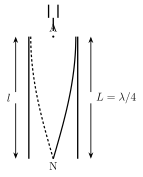
The simplest (FUNDAMENTAL) mode has just a single node at the closed end rising to a single antinode at the open end -- exactly one quarter of a wavelength fits into the air column, so , i.e. . Using (Eq. 6.15), the fundamental frequency is (Eq. 6.16) -- also called the FIRST HARMONIC, the lowest possible frequency of vibration for this pipe.
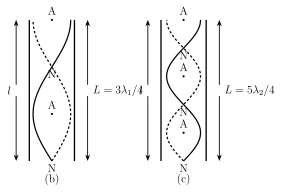
The next possible mode inserts one additional node and antinode: the air column now contains a node at the closed end, an antinode at the open end, and one more node-antinode pair in between -- THREE quarter-wavelengths fit into the same length L, so (Eq. 6.17), giving and, from , a frequency (Eq. 6.18) -- exactly three times the fundamental, so this is the THIRD HARMONIC, and (being the next higher frequency actually present) the FIRST OVERTONE. …
Drawn by us to help you understand the concept clearly, and verified to make sure it's accurate. For exams, practice from your textbook's own diagram.
What this figure shows. A tuning fork held over the open top of a pipe closed at the bottom sets the air column vibrating. In the fundamental mode there is a node at the closed end and an antinode at the open end, so the corrected length of the air column is L = λ/4. The length l of the pipe and the correct …
Drawn by us to help you understand the concept clearly, and verified to make sure it's accurate. For exams, practice from your textbook's own diagram.
What this figure shows. The next two modes of an air column closed at one end. (b) First overtone: a node at the closed end, an antinode at the open end, with one extra node-antinode pair in between, so L = 3λ₁/4 (the third harmonic). (c) Second overtone: two extra pairs, L = 5λ₂/4 (the fifth har …