Physics · Ch 6 — Superposition of Waves
Vibrations of air column in a pipe open at both ends
Vibrations of air column in a pipe open at both ends
Now consider a pipe OPEN at both ends, again excited by a tuning fork held near one end. Even with both ends open, the air inside the pipe is still confined by the tube's walls and is slightly denser than the free air outside, so an incident wave still undergoes PARTIAL reflection at the far open end; this partially reflected wave superposes with the still-arriving incident wave (which is itself reflected again, a second time, at the near open end where the source sits) and, under the right conditions, builds up a genuine stationary wave, exactly as in the closed-pipe case but now with the different boundary condition that BOTH ends -- not just one -- must be antinodes, since both ends are equally free.
The fundamental mode has an antinode at EACH of the two open ends with exactly one node in between them -- HALF a wavelength fits the air column, , i.e. ; from (Eq. 6.22), the fundamental frequency is (Eq. 6.23) -- the FIRST HARMONIC, and the lowest frequency this pipe can produce.
The next mode has three antinodes (both ends plus one more in the middle) and two nodes: ONE full wavelength fits the column, (Eq. 6.24), giving from a frequency (Eq. 6.25) -- the SECOND HARMONIC, and the FIRST OVERTONE.
The mode after that has four antinodes and three nodes: one-and-a-half wavelengths fit the column, (Eq. 6.26), giving (Eq. 6.27) -- the THIRD HARMONIC, and the SECOND OVERTONE. In general, the p-th overtone has frequency (Eq. 6.28), for ( recovering the fundamental). …
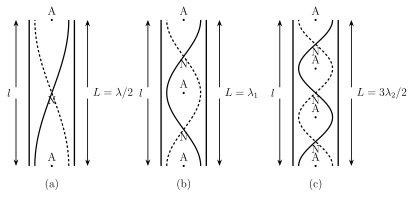
Drawn by us to help you understand the concept clearly, and verified to make sure it's accurate. For exams, practice from your textbook's own diagram.
What this figure shows. An air column open at both ends has an antinode at each open end. (a) Fundamental: one node in the middle, L = λ/2. (b) First overtone: two nodes, L = λ₁ (second harmonic). (c) Second overtone: three nodes, L = 3λ₂/2 (third harmonic). An open pipe produces ALL harmonics, so its …
Worked out. A hands-on activity, not a solved numerical: two pipes of slightly different diameters, both open at both ends, are arranged so the narrower one slides freely inside the wider one (which is clamped fixed to a stand), letting the experimenter continuously vary the effective length of the combined open-open air column by hand. A vibrating tuning fork of frequency 320 Hz or 288 Hz is held just above the open end of the fixed (wider) pipe, and the inner tube is moved in and out while listening for where the sound becomes noticeably LOUDER (resonance) versus where it fades. The activity is meant to be interpreted using the open-pipe mode results of this section: louder sound occurs whenever the length set by the sliding tube brings the air column close to for the fork's fixed frequency, i.e. whenever the tube length matches one of the pipe' …