Physics · Ch 6 — Superposition of Waves
Vibrations Produced in a String
Vibrations Produced in a String
Exactly the same standing-wave reasoning used for air columns (sections 6.7.2, 6.7.3) applies to a stretched STRING of length l, linear density (mass per unit length) m, held under tension T between two rigid supports. Since BOTH ends are rigidly fixed, both must always be NODES (with the usual -radian phase change on reflection at each, from section 6.3.1), and the possible standing-wave patterns are built up exactly as for a pipe open at both ends -- an antinode-node-antinode... structure, but here bounded by nodes at both ends instead of antinodes.
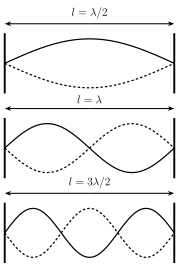
If the string is plucked exactly at its centre, it settles into the FUNDAMENTAL mode: a single loop, with an antinode at the centre and nodes only at the two fixed ends -- HALF a wavelength fills the string's length, , giving fundamental frequency (from and the wave speed on a stretched string, ) -- the FIRST HARMONIC.
If instead the string's exact centre is held motionless (touched lightly) while it is plucked at a point midway along one of the resulting halves, TWO equal loops form, with an additional node exactly at the centre -- a FULL wavelength fills the string, , giving -- the SECOND HARMONIC, or FIRST OVERTONE, exactly twice the fundamental frequency. …
Drawn by us to help you understand the concept clearly, and verified to make sure it's accurate. For exams, practice from your textbook's own diagram.
What this figure shows. A string fixed at both ends vibrates with nodes at the ends. (a) One loop — the fundamental, l = λ/2. (b) Two loops — the second harmonic (first overtone), l = λ. (c) Three loops — the third harmonic (second overtone), l = 3λ/2. The solid and dashed curves are the two extreme positions; al …
Worked out. This sub-section does not itself introduce a new hands-on activity; it continues directly from the two-telescoping-pipes resonance activity described under 'Vibrations of air column in a pipe open at both ends' (section 6.7.3), whose loudness-vs-length observations are meant to be interpreted using the open-pipe mode lengths derived there (), before this section moves the discussion on from air columns to strings. Students are expected to carry the same 'match the physical length to a normal-mode wavelength for resonance' reasoning forward into the vibrating-string results that follow immediately in this section (fundamental, first overtone, second overtone of a plucked st …