Physics · Ch 4 — Thermodynamics
Heat Engine
Heat Engine
Every heat engine, regardless of its specific design, shares three essential elements:
(1) A working substance — this is the 'system' in thermodynamic terms: the material that actually absorbs heat and does work. For an ideal heat engine it is typically taken to be an ideal gas; for a real, practical heat engine, it could be a mixture of fuel vapour and air (as in a petrol or diesel engine) or steam (as in a steam engine).
(2) A hot reservoir and a cold reservoir. The working substance interacts with two large reservoirs. The hot reservoir (also called the source) supplies heat at a fixed, relatively high temperature , large enough to be treated as an unlimited heat supply. The cold reservoir (also called the sink) absorbs the rejected heat at a fixed, relatively low temperature .
(3) A cylinder — generally, the working substance is enclosed in a cylinder fitted with a movable, frictionless, massless piston; the working substance does work by pushing this piston through some displacement, which is then transferred to the outside world through a mechanism such as a crankshaft (which, in a vehicle, ultimately turns the wheels).
Heat engines are broadly classified by how the working substance is heated. In an external combustion engine, such as a steam engine, the working substance is heated from outside the cylinder. In an internal combustion engine, such as a petrol or diesel automobile engine, the working substance (the fuel-air mixture itself) is heated internally, by burning the fuel directly inside the cylinder.
Every heat engine, in every design, works through the same three basic steps, repeated over and over: (1) the working substance absorbs heat from the hot reservoir at the higher temperature; (2) part of that absorbed heat is converted into work; (3) the remaining, unused heat is rejected to the cold reservoir at the lower temperature. One complete run through these three steps is called one operating cycle of the engine; a real engine repeats this cycle continuously while running (an automobile engine's RPM, or Revolutions Per Minute, is literally a measure of how many such cycles it completes per minute).
Let be the heat absorbed by the working substance from the source (by the earlier sign convention, is positive), and be the heat rejected to the sink (by convention, is negative, since it represents energy leaving the system). The net heat absorbed per cycle is:
Applying the First Law to one full cycle (where , since a cycle returns the system to its starting state, Section 4.7.3.6), the net work done by the working substance in one cycle is:
Since some heat is always lost as exhaust ( in practice, however small), no real heat engine converts 100% of the absorbed heat into work. The fraction of the absorbed heat that IS converted into useful work is called the engine's thermal efficiency, :
i.e. the ratio of output (work done) to input (heat supplied). Substituting Eq. (4.23) for :
…
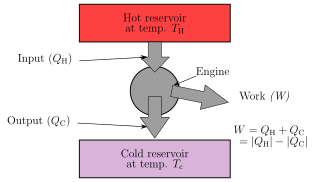
Drawn by us to help you understand the concept clearly, and verified to make sure it's accurate. For exams, practice from your textbook's own diagram.
What this figure shows. The working substance absorbs heat QH from a hot reservoir (at TH), converts part of it into useful work W, and rejects the remainder QC to a cold reservoir (at TC). The widths of the 'pipelines' are proportional to the energy they carry; W = |QH| − |QC|. A perfect eng …