Physics · Ch 4 — Thermodynamics
Limitations of the First Law of Thermodynamics
Limitations of the First Law of Thermodynamics
The First Law of Thermodynamics tells us that heat can be converted into work, and work can be converted into heat — it is, at its core, simply a quantitative statement of the equivalence between heat and work (Section 4.5). But being purely a statement of energy conservation, it has two significant practical limitations:
- It cannot predict which direction a process will actually occur in. According to the First Law alone, heat could — with no violation of energy conservation — flow spontaneously from a hotter object to a colder one, OR (equally validly, as far as the First Law is concerned) it could flow spontaneously from a colder object to a hotter one. But we know from everyday practical experience that heat NEVER flows spontaneously from a colder object to a hotter one — this observed, one-way direction is simply not something the First Law, by itself, predicts or explains.
- It does not forbid 100% conversion between heat and work. According to the First Law alone, it should be entirely possible to convert ALL (100%) of a given quantity of available heat completely into work, with nothing left over — and, equally, to convert all available work completely into heat. Again, practical experience tells us this simply never happens: no real heat engine has ever managed to convert 100% of its absorbed heat into work. These two genuine gaps — the missing preferred direction, and the missing cap on convertibility — are exactly what motivates the formulation of a further, independent principle: the Second Law of Thermodynamics, taken up formally in the next subsection. The irreversibility discussion of Section 4.7.3.1 already hinted at this: an irreversible process defines a preferred direction for change. And two very concrete practical facts reinforce the same point: it is impossible to build a heat engine with 100% efficiency (Eq. 4.25 can never reach in practice), and, symmetrically, it is impossible to build a refrigerator with an infinite coefficient of performance (Eq. 4.28's can never become unboundedly large in practice) — a refrigerator can never remove heat with literally zero work input. Both of these practical, unavoidable limits are exactly what the Second Law formalises. …
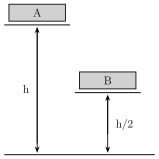
Drawn by us to help you understand the concept clearly, and verified to make sure it's accurate. For exams, practice from your textbook's own diagram.
What this figure shows. Object A sits at height h and object B, of the same mass, at height h/2. B's potential energy is half of A's, so at most half as much energy can be extracted from B. This mechanical analogy introduces the idea that a heat engine, too, can conve …
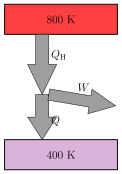
Drawn by us to help you understand the concept clearly, and verified to make sure it's accurate. For exams, practice from your textbook's own diagram.
What this figure shows. An energy-flow diagram for an engine receiving heat QH at 800 K and rejecting heat Q at 400 K while doing work W. The second law limits its maximum (Carnot) efficiency to 1 − TC/TH = 1 − 400/800 = 50%; no engin …