Physics · Ch 4 — Thermodynamics
The Second Law of Thermodynamics, Statement
The Second Law of Thermodynamics, Statement
The Second Law of Thermodynamics is a general principle that puts firm constraints both on the direction in which heat can spontaneously flow, and on the maximum possible efficiency any heat engine can ever achieve. It has two classic, and logically equivalent, statements — one focused on heat engines, the other focused on refrigerators.
The Kelvin-Planck statement (the 'Engine Law' or 'Engine Statement'): It is impossible to extract an amount of heat from a hot reservoir and use it ALL to do work . Some amount of heat must always be exhausted to a cold reservoir. This statement directly rules out the possibility of a 'perfect' heat engine — one that could convert 100% of its absorbed heat into work with nothing rejected — closing exactly the gap identified in Section 4.10.1(b).
The Clausius statement (the 'Refrigerator Law' or 'Refrigerator Statement'): It is not possible for heat to flow from a colder body to a warmer body without any work having been done to accomplish this flow. This statement directly rules out the possibility of a 'perfect' refrigerator — one that could move heat from cold to hot with zero work input — and it equally forbids energy flowing spontaneously (on its own, with no external work) from an object at low temperature to an object at higher temperature. This closes exactly the gap identified in Section 4.10.1(a), and, because refrigerators, air conditioners, and heat pumps all work on the same underlying principle (Section 4.9.1), the Clausius statement applies equally to all three devices. …
Drawn by us to help you understand the concept clearly, and verified to make sure it's accurate. For exams, practice from your textbook's own diagram.
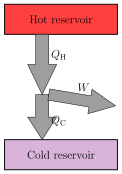
What this figure shows. A heat engine drawing QH from a hot reservoir, doing work W and rejecting QC to a cold reservoir. The Kelvin-Planck statement of the second law says this rejected heat can never be zero: it is impossible to build an e …
Drawn by us to help you understand the concept clearly, and verified to make sure it's accurate. For exams, practice from your textbook's own diagram.
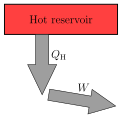
What this figure shows. The energy-flow diagram of a hypothetical perfect engine that takes in QH and turns ALL of it into work W, rejecting nothing. The second law (Kelvin-Planck) forbids such an engine — some heat must …
Drawn by us to help you understand the concept clearly, and verified to make sure it's accurate. For exams, practice from your textbook's own diagram.
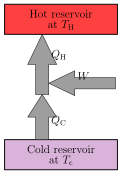
What this figure shows. A practical refrigerator needs work input W to extract heat QC from the cold reservoir (TC) and reject QH to the hot reservoir (TH). Heat will not flow from cold to hot on its own — this is …
Drawn by us to help you understand the concept clearly, and verified to make sure it's accurate. For exams, practice from your textbook's own diagram.
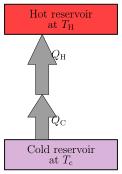
What this figure shows. A hypothetical perfect refrigerator that pumps heat from the cold reservoir to the hot reservoir with NO work supplied. The Clausius statement of the second law forbids it: spontaneous heat flow from …