Physics · Ch 7 — Wave Optics
Polarization by Reflection: Brewster's Law
Polarization by Reflection: Brewster's Law
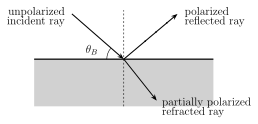
When unpolarized light travelling in a medium of refractive index strikes a boundary with a second transparent medium of refractive index at some angle of incidence, part of the light is reflected and part is refracted (transmitted) into the second medium. In GENERAL, both the reflected and the refracted beams end up only PARTIALLY polarized. But Sir David Brewster discovered experimentally, in 1812, that there is one SPECIAL angle of incidence, called the Brewster angle , at which the REFLECTED beam becomes COMPLETELY plane polarized -- with its electric field oscillating entirely PERPENDICULAR to the plane of incidence (the plane of the page in Fig. 7.8) -- while the refracted (transmitted) beam remains only partially polarized. At this special angle, the reflected and refracted rays turn out to be exactly PERPENDICULAR to each other: , where is the angle of refraction.
Drawn by us to help you understand the concept clearly, and verified to make sure it's accurate. For exams, practice from your textbook's own diagram.
What this figure shows. Unpolarized light incident at Brewster's angle θ_B on a transparent boundary: the reflected ray is completely plane polarized (field perpendicular to the plane of paper, shown by dots) and is perpendicular to the (partially polarized) refracted …
Combining this geometric condition with the ordinary law of refraction, , and substituting (so ) gives , i.e. -- this relation is BREWSTER'S LAW, and it lets the Brewster angle be calculated directly from the two media's refractive indices alone, with no need to separately measure anything about polarization itself. …