Physics · Ch 7 — Wave Optics
Wavefront
Wavefront
Picture dropping a stone into still water: circular ripples spread outward from the point of impact O. At any given instant, every water particle lying on one particular circle (a fixed distance from O) is doing exactly the same thing -- moving with the same velocity and the same displacement, perpendicular to the water's surface -- because they all started oscillating from the same source at the same distance and hence the same elapsed travel time. Two particles in this state -- same velocity, same displacement, same distance from the source -- are said to be IN PHASE. The locus of all points sharing the same phase at a given instant is called a WAVEFRONT. Equivalently, a wavefront is the set of all points that light (or any wave) starting simultaneously from the source has reached at one particular instant of time. For a stone dropped in water, these wavefronts are simply the growing circles themselves, all centred on O; the DIRECTION of propagation of the wave -- the direction its energy is actually travelling -- is always PERPENDICULAR to the wavefront at every point, which for circular water-wave wavefronts means straight out along the radii.
Water waves are essentially two-dimensional, since they only travel along the flat water surface. But sound waves from a source, or light waves from a light source, spread out in all THREE dimensions at once, and are correspondingly called SPHERICAL waves: their wavefronts are spheres centred on the source, since every point at a given distance in any direction has travelled for the same time and hence shares the same phase (Fig. 7.1(a)). The straight-line arrows perpendicular to these spherical wavefronts -- pointing radially outward -- are exactly the RAYS of light used throughout ordinary ray/geometrical optics; a diverging (spreading) beam of light corresponds to diverging spherical wavefronts, while a converging beam (such as light emerging from a converging lens, heading towards a focus) corresponds to converging spherical wavefronts.
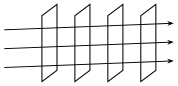
Drawn by us to help you understand the concept clearly, and verified to make sure it's accurate. For exams, practice from your textbook's own diagram.
What this figure shows. A small portion of a spherical wavefront far from the source appears flat — a plane wavefront. The parallel wavefronts (planes) carry parallel rays perpendicular to them, re …
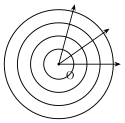
Drawn by us to help you understand the concept clearly, and verified to make sure it's accurate. For exams, practice from your textbook's own diagram.
What this figure shows. Concentric spherical wavefronts spreading out from a point source O. Each wavefront is the locus of all points vibrating in the same phase; the rays (arrows) are perpendicular to the wavefronts, poin …
…