Biology · Ch 4 — Animal Kingdom
Class – Amphibia
Class – Amphibia
Class Amphibia includes animals whose very name reflects their double life. The word comes from the Greek amphi, meaning dual, and bios, meaning life, because amphibians can live in both aquatic and terrestrial habitats. They form part of the super class Tetrapoda, the four-limbed vertebrates.
Body and limbs
Most amphibians have two pairs of limbs. The body is divided into a head and a trunk, and a tail is present in some forms. The skin is moist and lacks scales, and the eyes bear eyelids. The ear is represented externally by a membrane called the tympanum.
Internal openings and respiration
The alimentary canal, the urinary tract and the reproductive tract all open into a single common chamber, the cloaca, which in turn opens to the outside. Respiration takes place through gills, lungs and the skin — the moist skin itself serving as a respiratory surface.
Heart, temperature and reproduction
- The heart is three-chambered, made up of two auricles and one ventricle.
- Amphibians are cold-blooded. …
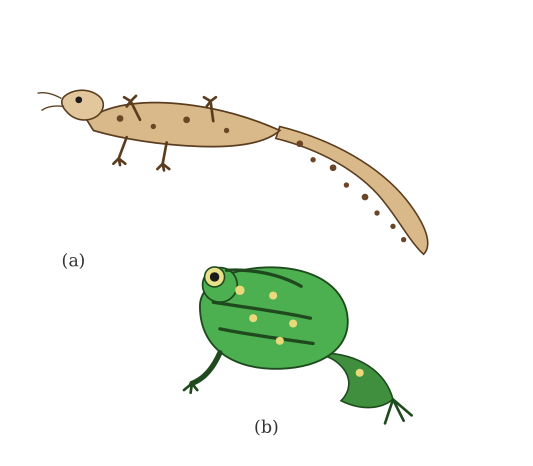
Drawn by us to help you understand the concept clearly, and verified to make sure it's accurate. For exams, practice from your textbook's own diagram.
These are amphibians of class Amphibia, animals adapted to live both on land and in water, which is what their name means. Their skin is moist, smooth and lacks scales, and it helps in breathing along with the lungs. Most have two pairs of limbs for moving on land, and they usually lack a neck and external ears. They are cold-blooded, and their eggs are laid in water where the young often begin life as gill-breathing larvae before changing into adults. Salamandra is a tailed amphibian resembling …