Biology · Ch 4 — Animal Kingdom
Class – Reptilia
Class – Reptilia
Class Reptilia takes its name from the way its members move: the Latin words repere and reptum mean to creep or to crawl, describing the reptilian mode of locomotion. Reptiles belong to the super class Tetrapoda.
Habitat and skin
Reptiles are mostly terrestrial. Their body is covered by a dry, cornified skin bearing epidermal scales or scutes — a covering that resists water loss and suits life on land. They lack external ear openings, and the ear is represented by the tympanum. Snakes and lizards periodically shed their scales as a skin cast.
Limbs
When limbs are present they number two pairs; in some reptiles, such as snakes, limbs are absent.
Heart, temperature and reproduction
- The heart is usually three-chambered, but in crocodiles it is four-chambered.
- Reptiles are poikilotherms (cold-blooded).
- Sexes are separate, fertilisation is internal, they are oviparous, and development is direct.
Examples
- Chelone (turtle)
- Testudo (tortoise) …
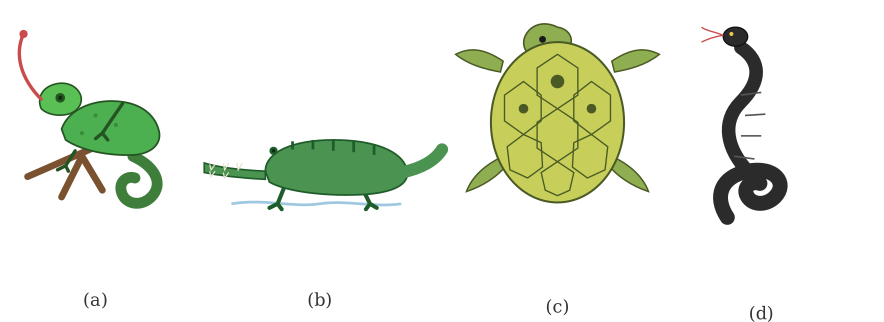
Drawn by us to help you understand the concept clearly, and verified to make sure it's accurate. For exams, practice from your textbook's own diagram.
These are reptiles of class Reptilia, mostly terrestrial, air-breathing animals. Their skin is dry and covered with horny scales or plates that prevent water loss and allow them to live away from water, unlike amphibians. They creep or crawl on the ground, and most have two pairs of limbs, though snakes have lost them. They are cold-blooded and breathe through lungs, and they lay shelled eggs on land. Chameleon is a colour-changing lizard, Crocodilus is the crocodile, Chelone is the sea turtle protected b …