Biology · Ch 4 — Animal Kingdom
Phylum – Aschelminthes
Phylum – Aschelminthes
Members of this phylum have a body that appears circular when cut across (circular in cross-section), which gives them the common name roundworms. They occupy a wide range of habitats: some are free-living in water or on land, while others live as parasites inside plants and animals.
Body organisation, symmetry, layers and cavity
- They show an organ-system level of body organisation, in which organs work together as systems.
- They are bilaterally symmetrical, with matching left and right halves.
- They are triploblastic, built from three germ layers.
- They are pseudocoelomate, meaning the body cavity present is a false coelom rather than a true one.
Digestive and excretory systems
The alimentary canal is complete, running from mouth to anus, and it includes a well-developed muscular pharynx that helps draw in and move food. An excretory tube carries body wastes out of the body cavity and releases them through an excretory pore.
Reproduction
- The sexes are separate (dioecious), so males and females are distinct individuals.
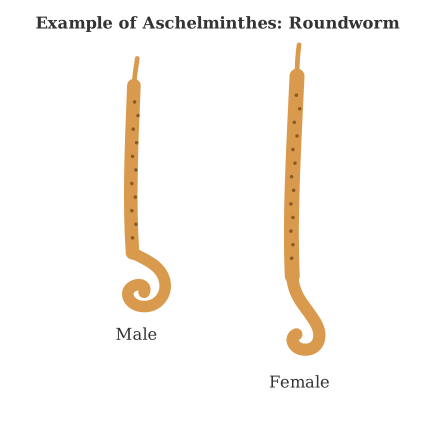
- The females are often longer than the males. …
Drawn by us to help you understand the concept clearly, and verified to make sure it's accurate. For exams, practice from your textbook's own diagram.
This figure shows a roundworm (Ascaris), the typical Aschelminthes body plan, drawn as a Male and a Female side by side to show how the two sexes differ. Both are cylindrical, tapering worms, but the male's posterior end curls into a small tight hook, while the female's posterior end is longer and ends in a broader, open curve rather than a hook. Aschelminthes are pseudocoelomate and bilaterally symmetrical, and the sexes are separate (dioecious), with females typically l …