Biology · Ch 4 — Animal Kingdom
Phylum – Platyhelminthes
Phylum – Platyhelminthes
The members of this phylum have a body that is flattened from the upper to the lower surface (dorso-ventrally flattened), which is why they are commonly called flatworms. Most of them live as endoparasites inside other animals, including human beings.
Symmetry, layers and body cavity
- They are bilaterally symmetrical, so a single plane divides the body into matching left and right halves.
- They are triploblastic, being built from three germ layers.
- They are acoelomate, meaning there is no true body cavity between the gut and the body wall.
- They show an organ level of organisation, with tissues arranged into organs.
Parasitic adaptations and nutrition
The parasitic forms are equipped with hooks and suckers that let them hold on to the host. Some of these worms take in nutrients straight through their body surface, absorbing food directly from the host rather than through a mouth.
Excretion and osmoregulation
Excretion and the control of water balance (osmoregulation) are carried out by specialised cells known as flame cells.
Reproduction and regeneration
- The sexes are not separate, so each animal carries both sets of reproductive organs. …
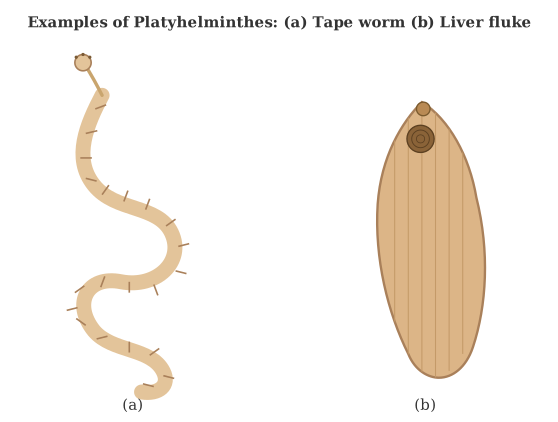
Drawn by us to help you understand the concept clearly, and verified to make sure it's accurate. For exams, practice from your textbook's own diagram.
These are flatworms of phylum Platyhelminthes. Their bodies are dorso-ventrally flattened, meaning pressed flat from top to bottom, which is why they are called flatworms. They are bilaterally symmetrical, triploblastic and acoelomate, having no body cavity. Many members are parasites living inside other animals, including humans; the tape worm and the liver fluke shown here both live inside host bodies and are equipped with hooks and suckers to hold on. Parasitic forms absorb nutrients directly through their body surface. Their excretion …