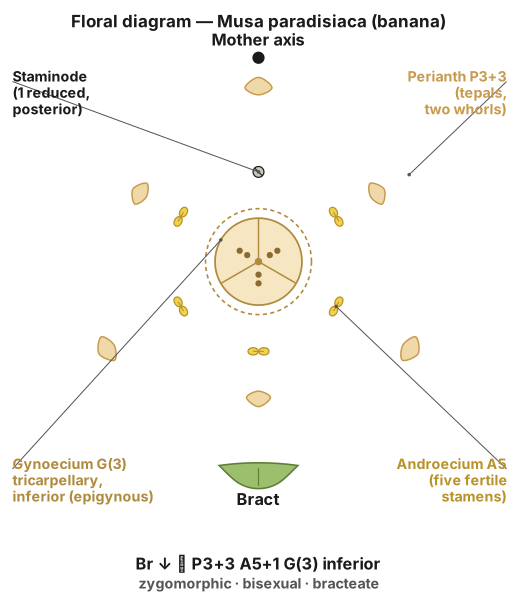
Floral Formula and Floral Diagram: A First Look
Imagine you are a botanist who has just collected a flower from the field. You need to record its structure — but you cannot carry a pressed flower everywhere, and a photograph does not show the internal arrangement of stamens and carpels. You need a shorthand, a code that captures everything about the flower in a single line or a simple sketch. That is exactly what a floral formula and a floral diagram do.
A floral formula is a symbolic code using letters, numbers, and signs. A floral diagram is a schematic cross-section of the flower bud, showing the relative positions of the whorls. Together they let you describe any flower precisely, without ambiguity.
The Intuition: What Must a Flower Description Capture?
A flower has four whorls, arranged from outside to inside:
- Calyx — the sepals (usually green, protective)
- Corolla — the petals (often coloured, attractive)
- Androecium — the stamens (male reproductive parts)
- Gynoecium — the carpels (female reproductive parts)
But that is not enough. You also need to know:
- Symmetry — Is the flower radially symmetric (actinomorphic) like a buttercup, or bilaterally symmetric (zygomorphic) like a pea flower, or asymmetric?
- Cohesion — Are the sepals free (polysepalous) or fused (gamosepalous)? Are the petals free (polypetalous) or fused (gamopetalous)? Are the stamens free or fused to each other or to the petals?
- Adhesion — Are the stamens attached to the petals (epipetalous)? Is the ovary superior or inferior?
- Number — How many sepals, petals, stamens, and carpels are there?
- Sex — Is the flower bisexual (bisexual) or unisexual (male or female)?
The floral formula encodes all of this. The floral diagram shows it visually.
The Floral Formula: The Code
A floral formula is written as a single line, usually starting with a symbol for symmetry, then the four whorls in order, and ending with the sex symbol. Here is the standard structure:
Symmetry[Calyx][Corolla][Androecium][Gynoecium]Sex
1. Symmetry
| Symbol | Meaning |
|---|
| ⊕ | Actinomorphic (radial symmetry) |
| % | Zygomorphic (bilateral symmetry) |
| ∗ | Asymmetric (rare) |
2. Calyx (K)
The letter K (from German Kelch) is used. Write the number of sepals after it. If the sepals are fused, put the number in brackets. If they are free, no brackets.
- K5 — 5 free sepals
- K(5) — 5 fused sepals
3. Corolla (C)
The letter C (from Latin Corolla) is used. Same rule: number in brackets if fused, no brackets if free.
- C5 — 5 free petals
- C(5) — 5 fused petals
4. Androecium (A)
The letter A (from Androecium). Write the number of stamens. If stamens are fused to the corolla (epipetalous), write the number after a line: A5∣C means 5 stamens attached to petals. If stamens are fused to each other, use brackets: A(5) means 5 stamens fused into a single bundle (monadelphous). Two bundles: A(5)+(5) (diadelphous). Many bundles: A(∞) (polyadelphous).
5. Gynoecium (G)
The letter G (from Gynoecium). Write the number of carpels, then a line, then the number of locules (chambers) in the ovary. The position of the ovary is shown by a line above or below the number:
- G3 — superior ovary, 3 carpels
- G3 — inferior ovary, 3 carpels
- G3 — half-inferior ovary (rare in Indian syllabus)
Often you will see G(3) if the carpels are fused (syncarpous) or G3 if free (apocarpous). The number of locules is written after a colon: G(3):3 means 3 fused carpels, 3 locules.
6. Sex
- ∧∧ or ◯ — bisexual flower
- \male — male (staminate) flower
- \female — female (pistillate) flower
Putting It All Together
A typical formula for a bisexual, actinomorphic flower with 5 free sepals, 5 free petals, many free stamens, and a superior ovary of 5 fused carpels:
⊕K5C5A∞G(5)
For a pea flower (zygomorphic, 5 fused sepals, 5 petals (one standard, two wings, two keel), 10 stamens (9 fused + 1 free), 1 carpel, superior ovary):
%K(5)C5A(9)+1G1
The Floral Diagram: The Picture
A floral diagram is a top view of the flower bud, drawn as if you sliced the bud horizontally just above the ovary and looked down. It shows the exact arrangement of the whorls.
Conventions
- The axis (stem) is drawn as a small circle or dot at the top of the diagram.
- The bract (a leaf-like structure below the flower) is drawn as a curved line opposite the axis.
- The calyx is drawn as the outermost whorl of sepals, usually green.
- The corolla is the next whorl, usually coloured (or drawn as outlines).
- The androecium is inside the corolla, drawn as stamens with anthers.
- The gynoecium is at the centre, drawn as a cross-section of the ovary showing the locules and ovules.
Key Rules for Drawing
-
Position relative to the axis: The posterior sepal (the one nearest the axis) is drawn at the top. The anterior sepal (opposite the axis) is at the bottom. This matters for zygomorphic flowers.
-
Cohesion: If sepals are fused, they are drawn touching each other. If free, they are drawn with gaps. Same for petals.
-
Adhesion: If stamens are epipetalous, they are drawn attached to the petals.
-
Placentation: The arrangement of ovules inside the ovary is shown in the centre. For example, marginal placentation (pea) shows ovules along the fused edge; axile placentation (tomato) shows ovules in the centre.
-
Symmetry: An actinomorphic flower has a diagram that looks the same from all sides. A zygomorphic flower has a clear left-right symmetry, with the axis at the top.
A Worked Example: Hibiscus (China Rose)
Let us apply this to a familiar flower.
Observation: Hibiscus has 5 sepals (fused at base), 5 petals (free, but twisted in bud), many stamens (fused into a tube around the style), 5 carpels (fused, superior ovary, 5 locules), actinomorphic, bisexual.
Floral formula:
⊕K(5)C5A∞G(5):5
Floral diagram (describe it):
- Axis at top.
- Bract below (epicalyx present in hibiscus, drawn as a whorl of small structures outside the calyx).
- Calyx: 5 fused sepals drawn as a continuous ring.
- Corolla: 5 free petals drawn as separate arcs inside the calyx.
- Androecium: Many stamens drawn as a ring of small circles (anthers) on a fused tube.
- Gynoecium: Central circle with 5 lines radiating from the centre (5 locules), each with ovules.
--- …