Q.(a) Rearrange the following terms based on techniques of plant tissue culture and explain.
You're viewing a preview — the full solution, concept, methods & PYQ mapping are locked.
Start your 14-day free trial to unlock the full solution →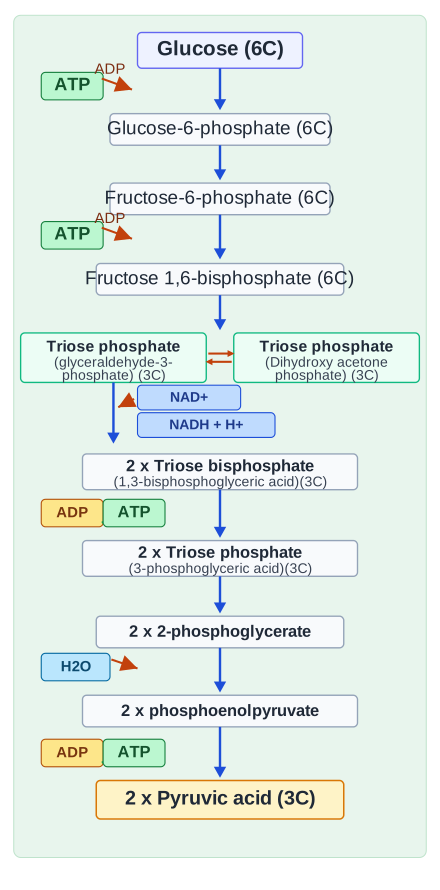
(a) The correct tissue-culture sequence is Inoculation -> Morphogenesis -> Embryogenesis -> Hardening; (b) glycolysis breaks down glucose to two pyruvic acid molecules in ten enzymatic steps in the cytoplasm.
(a) Correct sequence of plant tissue culture steps, explained
The terms given, rearranged into their correct technique order, are:
- Inoculation: a suitable explant (a piece of plant tissue, e.g. shoot tip, leaf, or single cell) is surface-sterilised and aseptically placed/transferred onto a sterile nutrient medium (commonly MS medium, containing minerals, sucrose, vitamins and plant growth regulators) inside a culture vessel.
- Morphogenesis (callus induction): under the influence of the growth regulators (auxin and cytokinin) in the medium, the explant's cells dedifferentiate and proliferate into an unorganised mass of actively dividing cells called a callus; depending on the hormone balance, the callus may then undergo organogenesis, differentiating into shoots and/or roots.
- Embryogenesis: in an appropriate hormonal environment, certain callus (somatic) cells instead develop directly into structures resembling zygotic embryos, called somatic embryos (embryoids), which have a bipolar structure (both shoot and root pole) capable of germinating into a complete plantlet, just like a seed embryo.
- Hardening: the tender plantlets regenerated in vitro (grown under sterile, high-humidity, controlled conditions) are gradually acclimatised to the natural external environment -- by slowly reducing humidity and increasing light exposure -- before they are finally transferred to soil/field conditions; this step is essential because in vitro plantlets are initially too delicate to survive direct transfer outdoors.
So the correct rearranged order is: (iii) Inoculation -> (i) Morphogenesis -> (iv) Embryogenesis -> (ii) Hardening.
(b) Glycolysis: glucose to pyruvic acid, as a flowchart
Glycolysis (the Embden-Meyerhof-Parnas pathway) occurs in the cytoplasm and converts one 6-carbon glucose molecule into two 3-carbon pyruvic acid molecules through ten enzyme-catalysed steps:
- Glucose + ATP --(hexokinase)--> Glucose-6-phosphate
- Glucose-6-phosphate --(isomerase)--> Fructose-6-phosphate
- Fructose-6-phosphate + ATP --(phosphofructokinase)--> Fructose-1,6-bisphosphate …
Unlock everything free for 14 days
- Full step-by-step solutions
- Concept-first explanations
- Methods, shortcuts & mistakes
- PYQ mapping + timed mock tests
Full access for 14 days. No credit card required.