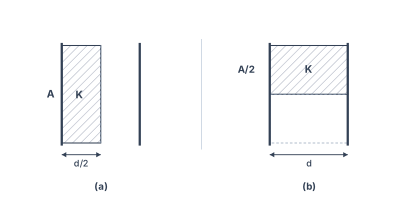
Q.A parallel plate capacitor has plate area and plate separation . Half of the space between the plates is filled with a material of dielectric constant in two ways as shown in the figure [(a) and (b)]. Find the values of the capacitance of the capacitors in the two cases.
You're viewing a preview — the full solution, concept, methods & PYQ mapping are locked.
Start your 14-day free trial to unlock the full solution →The key idea is to treat the partially filled capacitor as a combination of simpler capacitors — in series when the dielectric occupies a fraction of the gap (case a), and in parallel when it occupies a fraction of the plate area (case b). The results are and .
The Concept: Dielectric Insertion and Equivalent Capacitance
When a dielectric slab is inserted into a parallel plate capacitor, the capacitance changes because the electric field inside the dielectric is reduced by a factor . The trick is to see that the original capacitor gets split into regions — some with dielectric, some without — and these regions behave like separate capacitors connected either in series or in parallel, depending on the geometry.
The fundamental rule: if the dielectric boundary is parallel to the plates (so the field lines go through different materials in sequence), the regions are in series. If the boundary is perpendicular to the plates (so the field lines go through different materials side by side), the regions are in parallel.
Let's apply this to the two cases, shown in the figure below:
Case (a): Dielectric of thickness over the full plate area
Here, the dielectric slab sits on one plate, filling half the gap. The remaining half of the gap is empty (air/vacuum, ). The field lines go straight from one plate to the other, passing first through the dielectric, then through air.
This means the two regions are stacked along the field direction — they are in series.
Step 1: Identify the two capacitors
- Capacitor 1: dielectric of thickness , area , dielectric constant .
- Capacitor 2: air gap of thickness , area , dielectric constant .
Step 2: Combine in series
For capacitors in series:
Factor out :
Therefore:
Notice that if (no dielectric), this reduces to , the standard parallel plate formula — a good sanity check. …
Unlock everything free for 14 days
- Full step-by-step solutions
- Concept-first explanations
- Methods, shortcuts & mistakes
- PYQ mapping + timed mock tests
Full access for 14 days. No credit card required.