Question 95 of 122
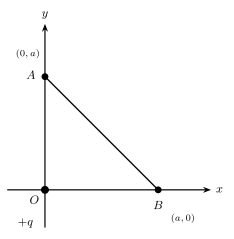
Q.In the given diagram a point charge +q is placed at the origin O. Work done in taking another point charge −Q from point A to point B is :
(a)
(b) Zero
(c)
(d)
Puducherry TnboardTamil Nadu HSC (DGE) Board 2020MCQ· 1mImportance★★★★★
78% · 95/122 Questions
You're viewing a preview — the full solution, concept, methods & PYQ mapping are locked.
Start your 14-day free trial to unlock the full solution →Points A and B are equidistant from the charge at O, so they are at the same potential; moving a charge between two points of equal potential does zero work.
Working
Given A is at and B is at , both a distance from the origin O, where the point charge sits.
The electric potential due to a point charge depends only on distance from it:
Since , — A and B lie on the same equipotential surface (a circle of radius centred at O).
…
Unlock everything free for 14 days
- Full step-by-step solutions
- Concept-first explanations
- Methods, shortcuts & mistakes
- PYQ mapping + timed mock tests
Full access for 14 days. No credit card required.