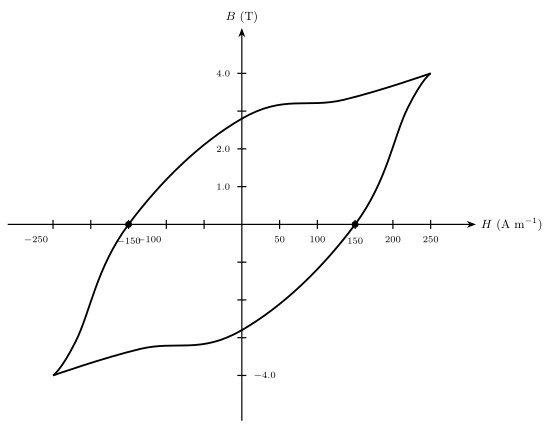
Hysteresis: The Memory of a Magnet
Imagine you push a heavy box across a rough floor. You shove it forward — it moves. You stop pushing — it stays where it is, not sliding back. To return it to the starting point, you have to push it backward, and even then it resists. The box "remembers" where it was last pushed, and the path you take to move it forward is not the same as the path you take to bring it back.
That lag — the dependence of where the box is on its history, not just on the force you apply right now — is the core of hysteresis.
The Intuition: Why a Ferromagnet Lags Behind
A ferromagnetic material (like iron) is made of tiny magnetic domains — regions where atomic magnetic moments are already aligned. In an unmagnetised state, these domains point in random directions, so the net magnetic field B inside the material is zero.
Now you apply an external magnetic field H (say, from a solenoid). The domains that are already aligned with H grow; the others shrink and rotate. The material becomes magnetised — B rises. But the domains do not move freely. They are pinned by impurities, grain boundaries, and internal stresses. They resist change.
When you increase H to a large value, all domains align — the material is saturated. Now you reduce H back to zero. Do the domains return to random directions? No. Many stay locked in their new alignment because the pinning forces hold them. The material retains a net magnetisation even with no external field. That leftover B is called retentivity (or remanence).
To force the domains back to randomness — to bring B to zero — you must apply a field in the opposite direction. The magnitude of that reverse field needed to demagnetise the material is called coercivity.
The B–H Loop: The Precise Picture
Plot B (magnetic flux density inside the material) against H (applied magnetic field). Start from an unmagnetised sample at the origin.
- Rise to saturation: Increase H from zero. B rises steeply at first (domains grow easily), then flattens as saturation approaches. Call this point S.
- Reduce H to zero: B does not retrace the rising curve. It falls more slowly, and at H=0, B=Br — the retentivity.
- Reverse H: Apply H in the opposite direction. B continues to fall, crossing zero at H=−Hc — the coercivity.
- Reverse saturation: Continue increasing reverse H until the material saturates in the opposite direction (point −S).
- Return to H=0: Reduce reverse H to zero. B now sits at −Br.
- Back to forward H: Increase H again. B crosses zero at +Hc and eventually rejoins the original saturation curve at S.
The curve does not close on itself on the first cycle. But after a few cycles, it traces a closed, symmetric loop — the hysteresis loop.
Area of B–H loop=∮HdB=Energy lost per cycle per unit volume …