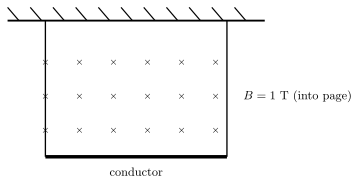
Q.A conductor of linear mass density 0.2 g m−1 is suspended by two flexible wires as shown in the figure (a horizontal straight conductor hung level by a vertical flexible wire at each end). Suppose the tension in the supporting wires is zero when the conductor is kept inside a magnetic field of 1 T whose direction is into the page. Compute the current inside the conductor and also the direction of the current. Assume g=10 m s−2.
Imagine a garden hose spraying pure water — bring a magnet near the stream and nothing happens, because water is electrically neutral. But if that stream carried electric charge (a current), the magnet would push the whole stream sideways. That is the essence of this concept: a current-carrying wire placed in a magnetic field experiences a sideways force, because every moving charge inside the wire feels the Lorentz force, and since the charges cannot leave the wire, they drag the wire along with them.
From a single charge to a wire
A single charge q moving with velocity v in a field B feels F=q(v×B). A current is just many such charges drifting together, so summing their individual forces over the whole wire gives a net force on it.
Note
The metal lattice itself is neutral and stationary — only the free electrons drift. The magnetic force acts on those drifting electrons, which then collide with the lattice and transfer the push to the entire wire.
The formula
For a straight wire of length L carrying current I in a uniform field B:
F=I(L×B),F=ILBsinθ
where L points along the current and θ is the angle between the wire and B.
Watch out
The force is zero when the wire runs parallel to the field (θ=0∘ or 180∘) and maximum when perpendicular (θ=90∘) — the magnetic force only responds to the component of current motion that is perpendicular to B.
Direction: the right-hand rule
Point your index finger along the current (L), your middle finger along the field (B); your thumb then gives the force direction — this is just the cross product L×B read off by hand. Because it is a cross product, swapping the two vectors reverses the force.
Worked example
A 0.5m wire carries 3A from east to west, in a uniform field of 0.2T pointing north.
θ=90∘ (the wire and the field are perpendicular), so F=ILBsinθ=(3)(0.5)(0.2)(1)=0.3N.
Direction: index finger west (current), middle finger north (field) — curling from west to north, the right-hand thumb points vertically downward. (Flip it: current flowing east with the same northward field gives a force straight up — reversing the current direction always reverses the force.)
Tip
For a wire that is not straight, in a uniform field the force still depends only on the net displacement vector from the start to the end of the wire, not on its actual curved path — a useful shortcut for irregular shapes.
Why it matters
This is the operating principle behind electric motors (opposite sides of a current loop feel opposite forces, producing rotation), galvanometers (a current-carrying coil deflects in a fixed field), and loudspeakers (a current-carrying voice coil is pushed back and forth by a magnet). It is not a new force — it is the same Lorentz force acting on the charges inside the wire, transmitted to the wire as a whole.
Queries like "force on current carrying conductor in magnetic field formula" and "moving charges and magnetism class 12 numericals" point to the Moving Charges and Magnetism chapter of the NCERT/CBSE Class 12 Physics curriculum. This same result underlies electric-motor and galvanometer questions commonly tested in JEE Main and NEET.
Figurea horizontal conductor suspended by two wires in a magnetic field of 1 T into the page — Class 12 Physics magnetism question
Zero tension means the magnetic force per unit length exactly balances the weight per unit length, giving I = (lambda g)/B = (2x10^-4)(10)/1 = 2 mA, with direction fixed by the right-hand/left-hand rule so the force points upward against gravity.
✓Final answer
I=2 mA, flowing in whichever direction makes Il×B point vertically upward.
Figurea horizontal conductor suspended by two wires in a magnetic field of 1 T into the page — Class 12 Physics magnetism question
Step 1. The conductor's weight per unit length is λg, where λ=0.2 g m−1=2×10⁻⁴ kg m−1 and g=10 m s−2, so weight/length =2×10⁻³ N m−1.
Step 2. With zero tension in the supporting wires, the magnetic force on the conductor must exactly balance this weight: (force/length) =BI, so BI=λg.
Step 3. Solve for I: I=Bλg=12×10−4×10=2×10⁻³ A =2 mA.
Step 4. Direction: the magnetic force Il×B must point vertically upward to balance gravity; with B into the page, applying F=Il×B (or equivalently Fleming's left hand rule with the force fixed as "up" and the field "into the page") fixes the required current direction along the conductor uniquely.
✓Final answer
I=2 mA, flowing in whichever direction makes Il×B point vertically upward.
Set the magnetic force per unit length BI equal to the weight per unit length lambda g, then solve for I.
Forgetting to convert the given linear density from g/m to kg/m before using it in F=mg.
Getting the current direction backwards, which would push the conductor down instead of holding it up.