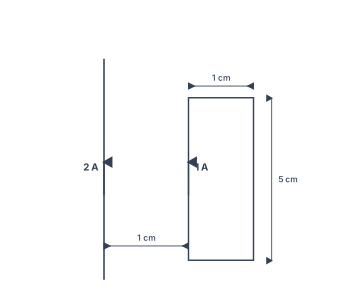
Q.A rectangular loop carries a current of 1 A. A straight long wire carrying 2 A current is kept near the loop in the same plane as shown in the figure. Find:
You're viewing a preview — the full solution, concept, methods & PYQ mapping are locked.
Start your 14-day free trial to unlock the full solution →The wire's field at the loop is perpendicular to the loop's plane, and so is the loop's magnetic moment — , so the torque is zero. The field is non-uniform, so the attractive force on the near arm exceeds the repulsive force on the far arm: with cm, cm and cm from the figure, the net force is N, directed towards the wire.
Setting up from the figure
The long straight wire carries A (upward) and the rectangular loop carries A, circulating so that the current in the near arm runs parallel to the wire's current. From the figure: the arms parallel to the wire have length ; the near arm is from the wire; the loop is wide, so the far arm is at .
The wire's field at a perpendicular distance is
directed perpendicular to the plane containing the wire and the loop — into the page everywhere on the loop's side of the wire. It is non-uniform: stronger at the near arm than at the far arm.
(i) Torque on the loop
The loop's magnetic moment is normal to the loop's plane; for the sense of circulation shown it points into the page. The field at the loop is also into the page, so and
Equivalently: every force on the loop lies in the loop's own plane — the forces on the two parallel arms act along the same horizontal line through their midpoints, and the forces on the two short arms act along the same vertical line — so no pair of forces forms a couple.
(ii) Net force on the loop
- Near arm (current parallel to the wire's current — parallel currents attract, so this arm is pulled towards the wire):
- Far arm (current antiparallel to the wire's — antiparallel currents repel, so this arm is pushed away from the wire): …
Unlock everything free for 14 days
- Full step-by-step solutions
- Concept-first explanations
- Methods, shortcuts & mistakes
- PYQ mapping + timed mock tests
Full access for 14 days. No credit card required.