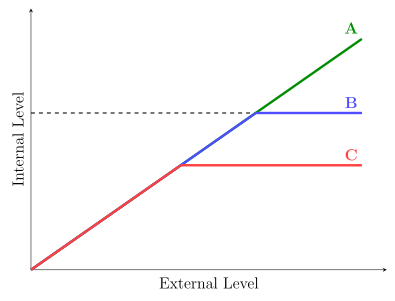
Q.The figure given below is a diagrammatic representation of response of organisms to abiotic factors. What do A, B and C represent respectively ?
You're viewing a preview — the full solution, concept, methods & PYQ mapping are locked.
Start your 14-day free trial to unlock the full solution →A straight diagonal line (internal level tracking external level exactly) represents a conformer; a curve plateauing at the ideal reference level represents a full regulator; a curve plateauing just below that represents a partial regulator.
Organisms respond to changes in abiotic (external) conditions in different ways, conventionally shown on a graph of internal physiological level against external environmental level. A conformer's internal level simply tracks the external level throughout the range shown -- graphically this is a straight, unbroken diagonal line, matching curve A in the figure, since the organism does not regulate its internal environment at all and instead lets it change directly with the surroundings (e.g., many aquatic invertebrates are thermoconformers). A regulator, by contrast, uses homeostatic mechanisms to actively maintain its internal environment relatively constant despite changes in the external environment, at least within tolerable limits -- graphically this shows an initial rise (before regulation is fully effective) followed by a plateau at a …
Unlock everything free for 14 days
- Full step-by-step solutions
- Concept-first explanations
- Methods, shortcuts & mistakes
- PYQ mapping + timed mock tests
Full access for 14 days. No credit card required.