Q.For an electrophilic substitution reaction, the presence of a halogen atom in the benzene ring _______. (Note: more than one of the given options may be correct.)
You're viewing a preview — the full solution, concept, methods & PYQ mapping are locked.
Start your 14-day free trial to unlock the full solution →
Halogens are deactivating groups (withdraw electrons inductively) but ortho-para directors (donate electrons by resonance to o/p positions). The correct options are (i) and (iii).
When a halogen substituent sits on a benzene ring, it plays a dual role that confuses many students at first: it slows down electrophilic substitution overall, yet steers the incoming electrophile to the ortho and para positions rather than meta. Understanding this apparent contradiction requires separating two electronic effects.
The two competing effects of halogens
Halogens (, , , ) are electronegative atoms directly bonded to the benzene ring. They influence reactivity through:
-
Inductive effect (): The halogen pulls -electron density away from the ring through the bond. This is a through-bond withdrawal that operates along the entire ring, lowering the overall electron density and making the ring less nucleophilic toward electrophiles.
-
Resonance effect ( or ): Each halogen carries lone pairs in p-orbitals that can overlap with the π-system of the benzene ring. This donates electron density by resonance, but the donation is not uniform—it is concentrated at the ortho and para positions.
The inductive effect dominates the overall reactivity (making halogens deactivating), while the resonance effect controls the regioselectivity (making them ortho-para directing).
Step-by-step analysis of each option
1. Option (i): "deactivates the ring by inductive effect"
The halogen's electronegativity withdraws -electrons from the ring. This lowers the π-electron density everywhere, making the ring less reactive toward electrophiles than benzene itself. Chlorobenzene, for instance, undergoes nitration or halogenation more slowly than benzene.
This statement is correct.
2. Option (ii): "deactivates the ring by resonance"
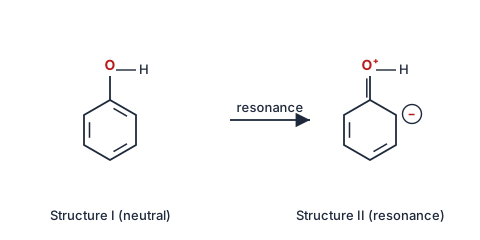
Resonance involving the halogen's lone pairs actually donates electron density into the ring. We can draw resonance structures where a lone pair from the halogen forms a π-bond with the ring, placing positive charge on the halogen and negative charge (increased electron density) on the ortho and para carbons:
This is an electron-donating (+R) effect, not withdrawing. Resonance does not deactivate; it partially offsets the inductive withdrawal and is responsible for the ortho-para directing nature.
This statement is incorrect.
A common mistake is to think that because halogens are electronegative, all their effects must be electron-withdrawing. Resonance donation (+R) and inductive withdrawal (−I) operate simultaneously; the former is weaker but directionally selective.
3. Option (iii): "increases the charge density at ortho and para position relative to meta position by resonance" …
Unlock everything free for 14 days
- Full step-by-step solutions
- Concept-first explanations
- Methods, shortcuts & mistakes
- PYQ mapping + timed mock tests
Full access for 14 days. No credit card required.