Q.Despite their -I effect, halogens are o- and p-directing in haloarenes. Explain.
You're viewing a preview — the full solution, concept, methods & PYQ mapping are locked.
Start your 14-day free trial to unlock the full solution →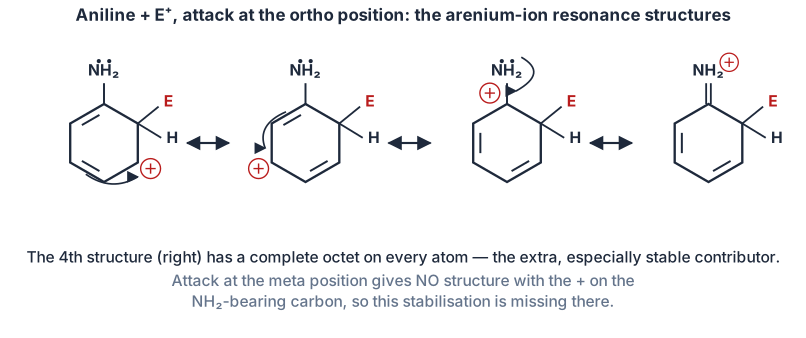
Halogens direct incoming electrophiles to the ortho and para positions despite withdrawing electrons through the σ-framework because their lone pairs donate electron density by resonance into the π-system of the benzene ring, stabilising the σ-complex intermediates at those positions.
The puzzle here is that halogens seem to send contradictory signals. Through their electronegativity they pull electrons away from the ring (the effect), which should deactivate the benzene and make substitution harder. Yet when substitution does occur, the incoming group lands ortho or para to the halogen—the hallmark of an activating, electron-donating substituent. Understanding this requires looking at where electrons matter most in electrophilic aromatic substitution: in the intermediate, not the starting material.
Why directing matters: the σ-complex intermediate
Electrophilic aromatic substitution proceeds through a high-energy carbocation intermediate called the σ-complex (or arenium ion). The position that forms the most stable σ-complex reacts fastest. A substituent directs by stabilising (or destabilising) this intermediate at different positions around the ring.
Halogens have two electronic effects working simultaneously:
-
effect (inductive withdrawal): The halogen atom is more electronegative than carbon, so it withdraws electron density through the σ-bonds. This operates through space and the σ-framework, pulling electrons away from all positions on the ring. It deactivates the benzene overall.
-
effect (resonance donation): Each halogen carries lone pairs of electrons in -orbitals that can overlap with the π-system of the benzene ring. This donates electron density by resonance, but only to positions ortho and para to the halogen.
The key insight: the effect is weaker than the effect overall (so halogens deactivate), but the effect is geometrically selective and stabilises the σ-complex at ortho and para positions.
Step-by-step: how halogens direct ortho/para
- Attack at the ortho position When the electrophile attacks ortho to the halogen, the positive charge in the σ-complex is distributed over three carbons, one of which is directly adjacent to the halogen. We can draw resonance structures for this carbocation:
In that structure, the lone pair on the halogen can delocalise into the empty -orbital on the adjacent positively charged carbon, forming a structure with a character. This extra resonance form—where the halogen donates electron density—stabilises the intermediate.
-
Attack at the para position
Similarly, when attacks para to the halogen, one of the resonance structures again places the positive charge on the carbon bearing the halogen. The lone pair on the halogen delocalises into that positive centre, providing the same stabilisation.
-
Attack at the meta position
When the electrophile attacks meta, the three resonance structures for the σ-complex place the positive charge on carbons that are not adjacent to the halogen. The halogen's lone pairs cannot overlap effectively with these positions—they are too far away. The stabilisation is absent. Only the effect operates, destabilising the intermediate by withdrawing electrons.
-
Net result …
Unlock everything free for 14 days
- Full step-by-step solutions
- Concept-first explanations
- Methods, shortcuts & mistakes
- PYQ mapping + timed mock tests
Full access for 14 days. No credit card required.