Chemistry · Ch 9 — Amines
Reactions Involving Displacement of Nitrogen
Reactions Involving Displacement of Nitrogen
The diazonium group is a very good leaving group, and when the ring reacts with a suitable nucleophile, nitrogen is expelled from the molecule as gas while the nucleophile takes its place on the aromatic carbon. Because the leaving group departs as a stable, inert gas, these substitutions are driven strongly to completion and give clean, high-yielding routes to substituted benzenes.
1. Replacement by Halide or Cyanide Ion
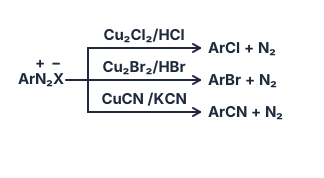
Chloride, bromide, and cyanide can all be introduced onto the ring in the presence of copper(I) ions. This copper(I)-mediated substitution is called the Sandmeyer reaction:
Drawn by us to help you understand the concept clearly, and verified to make sure it's accurate. For exams, practice from your textbook's own diagram.
Redrawn from the NCERT page with the structures, printed labels (ArN2X, Cu2Cl2/HCl, Cu2Br2/HBr, CuCN /KCN, ArCl + N2, ArBr + N2, ArCN + N2) and reagent placement exactly as the textbook prints them. Every element of this display was checked against the printed page during the sweep's blind-judge verification pas …
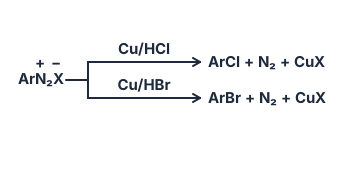
Chlorine or bromine can also be installed by treating the diazonium salt solution with the corresponding halogen acid in the presence of copper powder rather than a copper(I) salt. This variant is called the Gattermann reaction:
Drawn by us to help you understand the concept clearly, and verified to make sure it's accurate. For exams, practice from your textbook's own diagram.
Redrawn from the NCERT page with the structures, printed labels (ArN2X, Cu/HCl, Cu/HBr, ArCl + N2 + CuX, ArBr + N2 + CuX) and reagent placement exactly as the textbook prints them. Every element of this display was checked against the printed page during the sweep's blind-judge verification pass, …
Between the two, the Sandmeyer route consistently gives a better yield of the aryl halide than the Gattermann route.
2. Replacement by Iodide Ion
Iodine cannot be introduced onto the benzene ring directly by ordinary halogenation, and this is exactly where diazonium chemistry fills the gap. Simply shaking or treating the diazonium salt solution with potassium iodide converts it to the aryl iodide — no copper catalyst is required here, unlike the chloride/bromide case:
3. Replacement by Fluoride Ion — the Balz–Schiemann Reaction
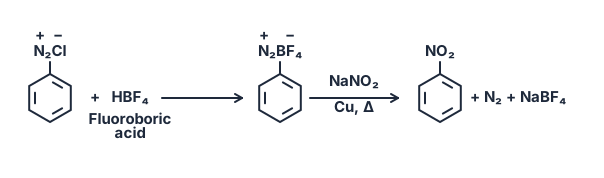
Fluorine is introduced by a two-step sequence rather than a direct swap. The arenediazonium chloride is first treated with fluoroboric acid (), which precipitates the diazonium fluoroborate salt. On heating (dry, solid-state decomposition), this salt breaks down to give the aryl fluoride, boron trifluoride, and nitrogen. This overall two-step conversion is commonly known as the Balz–Schiemann reaction:
This route matters because, like iodine, aryl fluorides cannot be made by direct fluorination of benzene.
4. Replacement by Hydrogen — Reductive Deamination
Certain mild reducing agents can strip the diazonium group off the ring and put a hydrogen atom in its place, effectively removing the amino group from the original aromatic amine altogether (hence the name "reductive deamination"). Two common reducing agents for this are hypophosphorous acid (phosphinic acid, ) and ethanol; each reagent is itself oxidised in the process — hypophosphorous acid to phosphorous acid, ethanol to acetaldehyde:
This reaction is synthetically useful as a way of removing an group from a ring once it has served its purpose as a director during earlier substitution steps.
5. Replacement by Hydroxyl Group
If the diazonium salt solution is simply allowed to warm up in water, it hydrolyses to phenol, with nitrogen and the corresponding acid released as by-products. This works because, on warming, water itself acts as the nucleophile that displaces nitrogen: …
Drawn by us to help you understand the concept clearly, and verified to make sure it's accurate. For exams, practice from your textbook's own diagram.
Redrawn from the NCERT page with the structures, printed labels (N2Cl, HBF4, Fluoroboric, acid, N2BF4, NaNO2, Cu, Δ, NO2, + N2 + NaBF4) and reagent placement exactly as the textbook prints them. Every element of this display was checked against the printed page during the sweep's blind-judge verification pass …