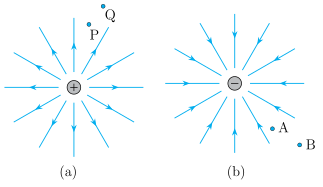
Q.Figures 2.8(a) and
You're viewing a preview — the full solution, concept, methods & PYQ mapping are locked.
Start your 14-day free trial to unlock the full solution →A point charge gives , so potential falls with distance from a positive charge and rises (becomes less negative) with distance from a negative charge. With and , all the signs follow: (a) both differences ;
(b) both PE differences ;
(c) negative;
(d) positive; (e) KE decreases.
Concept understanding
Electric potential is a scalar equal to the work per unit positive charge to bring it from infinity. For a point charge,
so for a positive charge is positive and decreases with (P nearer ), while for a negative charge is negative and becomes less negative with (B farther ). The potential energy of a test charge is , and the work done by the field is .
Part-by-part
(a) For the positive charge P is closer than Q, so and . For the negative charge A is closer than B, so is more negative, giving and .
(b) For a small negative test charge, with , so has the sign opposite to .
- QP: , so — positive.
- AB: , so — positive.
(c) Moving a positive charge from Q (lower ) to P (higher ) is against the field, so the field does negative work: . …
Unlock everything free for 14 days
- Full step-by-step solutions
- Concept-first explanations
- Methods, shortcuts & mistakes
- PYQ mapping + timed mock tests
Full access for 14 days. No credit card required.