Q.In a region of constant potential
🔒You're viewing a preview — the full solution, concept, methods & PYQ mapping are locked.
🔒 Start your 10-day free trial to unlock the full solution →Concept understanding — Electric Potential
Electric Potential
The Idea
When you lift a book onto a shelf you do work against gravity, and the book gains gravitational potential energy that depends on where it sits. Electric charges behave the same way in an electric field. Electric potential is the electrical analogue of "height" in a gravitational field: it tells you the potential energy a unit charge would have at a given point.
Formally, the electric potential at a point is the work done in bringing a unit positive charge from infinity to that point, slowly (without giving it kinetic energy), against the electric field.
V=q0W
Here W is the work done to move a small test charge q0 from infinity to the point. Because both W and q0 are scalars, electric potential is a scalar quantity — it has magnitude but no direction. Its SI unit is the volt:
1 V=1 J/C
Potential Due to a Point Charge
For a single point charge q, the potential at a distance r from it is
V=4πε01rq
Notice it falls off as 1/r, whereas the electric field of a point charge falls off as 1/r2. The potential is taken as zero at infinity, our chosen reference. A positive charge makes the potential around it positive; a negative charge makes it negative.
Potential Difference
Usually we care about the potential difference between two points A and B:
VA−VB=q0WB→A
the work per unit charge needed to move a charge from B to A. This is the quantity a voltmeter reads and the "voltage" that drives current in a circuit.
Relation Between Field and Potential
Field and potential are two views of the same thing. The electric field is the negative rate of change of potential with distance:
E=−drdV
The minus sign says the field points from high potential toward low potential — a positive charge, left free, rolls "downhill" in potential. Where the potential changes steeply, the field is strong.
Superposition
Because potential is a scalar, the potential due to several charges is just the algebraic sum of their individual potentials — no vectors, no angles:
V=4πε01(r1q1+r2q2+⋯)
This makes potential far easier to compute than the field, which needs vector addition. Once you have V everywhere, you can get the field by differentiating.
Equipotential Surfaces
An equipotential surface is a surface on which the potential has the same value everywhere.
- No work is done in moving a charge along an equipotential surface (since ΔV=0).
- The electric field is always perpendicular to an equipotential surface. …
Constant V throughout a region ⇒∇V=0⇒E=0 there (option b). Applying Gauss's law to any closed surface drawn entirely inside this zero-field region gives zero flux, hence zero enclosed charge for every such surface — so the region can contain no charge at all (option c). (d) is false: an external charge placement doesn't necessarily disturb th …
If V is constant throughout a region, E=−∇V=0 there — the field is zero, option (b) — and applying Gauss's law to any surface drawn entirely inside that region then forces the enclosed charge to be zero too, so there can be no charge inside, option (c). Correct options: (b) and (c).
From constant potential to zero field
By definition, E=−∇V. If V has the same value at every point throughout the region, then every partial derivative of V (with respect to x, y, z) is zero there, so
∇V=0⟹E=0 everywhere in the region.
This is exactly option (b): the electric field is zero (not merely "uniform" in the weaker sense of option (a) — see the note below).
From zero field to zero enclosed charge
Now apply Gauss's law to any closed surface S drawn entirely inside this region. Since E=0 at every point of S (the whole surface lies in the region of constant potential), the flux through S is
∮SE⋅dS=0⟹qenc=0.
This holds for every such surface we can draw inside the region — including surfaces that shrink down around any point we like. If there were any charge sitting inside the region, we could always draw a small enough Gaussian surface around it to enclose a non-zero charge, contradicting the result above. So the region must contain no charge at all — option (c). (This is the identical Gauss's-law argument used to show that a conductor's excess charge sits only on its outer surface: the interior, being at constant potential with E=0, cannot hold any net charge.)
Why not (a)?
Option (a) says only that the field is "uniform" — meaning the same everywhere, which would technically include the zero field as one special case. But the stronger, more specific fact established above is that the field isn't merely constant, it is identically zero — option (b) already says the sharper, correct thing, so (a) is not the fact being tested here.
Why not (d)? …
Method: From "Constant Potential" to "Zero Charge Inside" via Gauss's Law
Use this method whenever a question describes a region of constant potential and asks what that implies about the field or the charge inside it.
Steps
Step 1: Convert constant potential into zero field
If V is the same at every point of a region, every partial derivative of V vanishes there, so
E=−∇V=0throughout the region.
Step 2: Apply Gauss's law to a surface drawn inside the region
Take any closed surface S lying entirely within the constant-potential region. Since E=0 everywhere on S,
∮SE⋅dS=0⟹qenc=0.
Step 3: Generalise to every possible surface …
Showing the 12 most recent of 19 on this concept.
- JEE Main 2026Set 2026-01-21-s14 marksMCQQ.A point charge of 10^-8 C is placed at origin. The work done in moving a point charge 2 μC from point A(4, 4, 2)m to B(2, 2, 1)m is ____ J. (1/(4πε₀) = 9 × 10^9 in SI units) (A) 45 × 10^-6 (B) 30 × 10^-6 (C) 0 (D) 15 × 10^-6
›Reveal solutionSolution
Work done against a point charge's field is path-independent and equals q(VB−VA); computing VA and VB gives W=30×10−6 J.
The electric field of a point charge is conservative, so the work done in moving a test charge between two points depends only on the potentials at those points, not on the path taken.
- rA=42+42+22=36=6 m, rB=22+22+12=9=3 m. …
- JEE Main 2026Set 2026-04-02-s24 marksMCQQ.Two metal plates (A, B) are kept horizontally with separation of (12/pi) cm, with plate A on the top. An atomizer jet sprays oil (density 1.5 g/cm^3) droplets of radius 1 mm horizontally. All oil droplets carry a charge 5 nC. The potentials V_A and V_B are required on plates A and B respectively in order to ensure the droplets do not descend. The values of V_A and V_B are ________. (Neglect the air resistance to the droplets and take g = 10 m/s^2) (A) 100 V and 580 V (B) 580 V and 100 V (C) 60 V and 400 V (D) 0 V and -200 V
›Reveal solutionSolution
Balancing electric force against gravity gives a required potential difference of exactly 480 V between the plates (the π in the plate separation conveniently cancels), and the direction needed (field pointing upward) identifies VA=100V, VB=580V as the consistent pair.
This is a Millikan-oil-drop-style setup: the field between the plates must push the charged droplet up with a force exactly equal to its weight, and the plate separation was deliberately chosen (as a multiple of π) so that π cancels cleanly in the final answer.
- Droplet mass: m=ρ⋅34πr3=1500×34π(0.001)3.
- Weight: mg=ρ⋅34πr3⋅g.
Balance condition: qE=mg ⇒ E=qmg, and V=E⋅d
- V=qmg⋅d=qρ⋅34πr3⋅g×π0.12 — the π cancels, leaving V=qρ⋅34r3⋅g×0.12.
- Plug in: ρ=1500, r3=10−9, g=10, q=5×10⁻⁹: …
- JEE Main 2026Set 2026-01-24-s14 marksMCQQ.There are three co-centric conducting spherical shells A, B and C of radii a, b and c respectively (c > b > a) and they are charged with charges q1, q2 and q3 respectively. The potentials of the spheres A, B and C respectively, are: (A) 1/(4πεo) × (q1+q2+q3)/a , 1/(4πεo) × (q1+q2+q3)/b , 1/(4πεo) × (q1+q2+q3)/c (B) 1/(4πεo) × (q1/a + q2/b + q3/c) , 1/(4πεo) × ((q1+q2)/b + q3/c) , 1/(4πεo) × (q1+q2+q3)/c (C) 1/(4πεo) × (q1/a + q2/b + q3/c) , 1/(4πεo) × (q1+q2+q3)/b , 1/(4πεo) × (q1+q2+q3)/c (D) 1/(4πεo) × (q1+q2+q3)/a , 1/(4πεo) × ((q1+q2)/b + q3/c) , 1/(4πεo) × (q1/a + q2/b + q3/c)
›Reveal solutionSolution
Each shell's own charge behaves like a point charge for points at or outside it, but contributes a CONSTANT potential (its own surface value) for points strictly inside it -- applying this rule at each of A, B, C gives option (B) directly.
For a uniformly charged spherical shell, the potential outside (or on) the shell follows the point-charge formula kQ/r, while INSIDE the shell the field is zero and the potential stays constant at the value it had on the surface.
- At A (innermost, r=a): q1 is on this shell itself -> kq1/a. q2's shell (radius b>a) surrounds point A, so q2 contributes its constant surface value, kq2/b. Similarly q3 contributes kq3/c. Total: V_A = k(q1/a+q2/b+q3/c).
Charge on a shell of radius R contributes kQ/r for points with r>=R, and kQ/R (constant) for points with r<R …
- JEE Main 2026Set 2026-01-28-s14 marksMCQQ.Two point charges of 1 nC and 2 nC are placed at the two corners of an equilateral triangle of side 3 cm. The work done in bringing a charge of 3 nC from infinity to the third corner of the triangle is ______ μJ. 1/4πε₀ = 9 × 10⁹ N.m²/C² (A) 27 (B) 3.3 (C) 2.7 (D) 5.4
›Reveal solutionSolution
Both existing charges are equidistant (3 cm) from the target corner, so their potentials simply add, giving a work of 2.7 μJ.
In an equilateral triangle, every corner is the same distance from both other corners, so the potential at the empty corner is just the sum of the two individual point-charge potentials at that one common distance.
W=q3(rkq1+rkq2)=rkq3(q1+q2)
- W=0.03(9×10⁹)(3×10⁻⁹)(1×10⁻⁹+2×10⁻⁹). …
- JEE Main 2025Set 2025-04-03-s14 marksMCQQ.The electrostatic potential on the surface of uniformly charged spherical shell of radius R = 10 cm is 120 V. The potential at the centre of shell, at a distance r = 5 cm from centre, and at a distance r = 15 cm from the centre of the shell respectively, are: (A) 0 V, 120 V, 40 V (B) 120 V, 120 V, 80 V (C) 40 V, 40 V, 80 V (D) 0 V, 0 V, 80 V
›Reveal solutionSolution
Inside the shell (r≤R) the potential is uniform and equal to the surface potential (120 V); outside (r>R) it scales as R/r, giving 80 V at r=15 cm.
- Inside the shell (r<R). The electric field inside a uniformly charged spherical shell is zero (by Gauss's law, since the enclosed charge is zero for any r<R). Zero field means the potential does not change from the surface inward, so
V(r)=V(R)=120 Vfor all r≤R
This gives the potential at the centre (r=0) and at r=5 cm both equal to 120 V. …
- JEE Main 2025Set 2025-01-23-s24 marksMCQQ.Two charges 7µc and −4µc are placed at (−7 cm, 0, 0) and (7 cm, 0, 0) respectively. Given, ε₀ = 8.85×10⁻¹² C² N⁻¹ m⁻², the electrostatic potential energy of the charge configuration is : (A) −2.0 J (B) −1.5 J (C) −1.2 J (D) −1.8 J
›Reveal solutionSolution
U=kq1q2/r with r=0.14 m gives U=−1.8 J, negative because the charges attract.
Two opposite charges have negative potential energy because energy was released bringing them together from infinity (the reference U(∞)=0); pulling them back apart would require positive work equal in magnitude.
- Separation: from x=−7 cm to x=+7 cm ⇒r=14 cm =0.14 m.
- k=4πε01=4π×8.85×10−121≈9×10⁹ N·m²/C². …
- JEE Main 2025Set 2025-01-28-s14 marksMCQQ.Three infinitely long wires with linear charge density λ are placed along the x-axis, y-axis and z-axis respectively. Which of the following denotes an equipotential surface? (A) (x² + y²)(y² + z²)(z² + x²) = constant (B) xyz = constant (C) xy + yz + zx = constant (D) (x + y)(y + z)(z + x) = constant
›Reveal solutionSolution
An infinite line charge's potential depends on the log of the perpendicular distance from it; summing three such potentials (one per axis) and exponentiating the equipotential condition converts a sum of logs into a product of distance-squared terms.
- Potential due to an infinite line charge of linear density λ at perpendicular distance s: V(s)=−2πε0λlns+const.
- Perpendicular distances from the point (x,y,z) to each axis:
- distance to the x-axis: y2+z2
- distance to the y-axis: x2+z2
- distance to the z-axis: x2+y2
- Total potential (superposition of the three wires): …
- JEE Main 2025Set 2025-04-08-s24 marksMCQQ.Given below are two statements: one is labelled as Assertion A and the other is labelled as Reason R Assertion A : Work done in moving a test charge between two points inside a uniformly charged spherical shell is zero, no matter which path is chosen. Reason R : Electrostatic potential inside a uniformly charged spherical shell is constant and is same as that on the surface of the shell. In the light of the above statements, choose the correct answer from the options given below. (A) A is true but R is false (B) Both A and R are true and R is the correct explanation of A (C) Both A and R are true but R is NOT the correct explanation of A (D) A is false but R is true
›Reveal solutionSolution
Gauss's law gives zero field inside a uniform spherical shell, which makes the potential inside constant (equal to the surface potential); a constant potential directly forces zero work in moving a charge between any two interior points.
1. Field inside the shell
By Gauss's law, for a sphere of radius r<R (inside a uniformly charged shell of radius R) the enclosed charge is zero, so:
Einside=0
2. Potential inside the shell
Since V(r)−V(R)=−∫RrEdr, and E=0 for all r<R:
V(r)=V(R)=constantfor r≤R
This is exactly Reason R.
3. Work done moving a charge inside
W=q0(VA−VB) …
- JEE Main 2024Set 2024-01-27-s14 marksMCQQ.An electric charge 10−6μC is placed at the origin (0,0) m of an X-Y coordinate system. Two points P and Q are situated at (3,3) m and (6,0) m respectively. The potential difference between the points P and Q will be: (A) 6 V (B) 0 V (C) 3 V (D) 3 V
›Reveal solutionSolution
Compute the distance of each point from the charge; equal distances mean equal potentials, so the difference vanishes.
(a) Rod of length L and resistance R cut into 5 equal L/5 segments each R/5; (b) the five R/5 resistors connected in parallel between A and The potential of a point charge depends only on the radial distance, so we compare ∣OP∣ and ∣OQ∣. …
- JEE Main 2024Set 2024-01-27-s24 marksMCQQ.Given below are two statements; one is labelled as Assertion (A) and the other is labelled as Reason (R). Assertion (A): Work done by the electric field on moving a positive charge on an equipotential surface is always zero. Reason (R): Electric lines of force are always perpendicular to equipotential surfaces. In the light of the above statements, choose the most appropriate answer from the options given below: (A) Both (A) and (R) are correct and (R) is the correct explanation of (A) (B) (A) is correct but (R) is not correct (C) (A) is not correct but (R) is correct (D) Both (A) and (R) are correct but (R) is not the correct explanation of (A)
›Reveal solutionSolution
Both statements are individually true, but the perpendicularity of field lines is not the actual explanation for zero work — the definitional equality of potential is.
- Work done by the electric field in moving a charge q between two points is W=q(Vi−Vf). On an equipotential surface, Vi=Vf by definition, so W=0 for ANY path confined to that surface. This directly confirms Assertion (A).
- Reason (R) states field lines are always perpendicular to equipotential surfaces — this is a standard, true property of electrostatic fields (field lines point along the direction of steepest potential decrease, which is normal to surfaces of constant potential). …
- JEE Main 2024Set 2024-01-31-s24 marksQ.The distance between charges +q and −q is 2l, and between +2q and −2q is 4l. The electrostatic potential at point P, at a distance r from centre O, is −α[r2ql]×109 V, where the value of α is ______. (Use 4πε01=9×10⁹ N m2C−2) [FIGURE]
›Reveal solutionSolution
Collapse the four-charge line into its net dipole moment, then use the standard far-field dipole potential formula at the given angle.
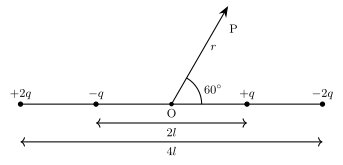
A horizontal line with four point charges placed in order from left to right: +2q, -q, O (the reference origin point, between -q and +q), +q - The charges along the line, in order, are +2q,−q,O,+q,−2q with −q,+q separated by 2l (dipole moment p1=q⋅2l=2ql) and +2q,−2q separated by 4l (dipole moment p2=2q⋅4l=8ql, oriented oppositely to p1).
- Net dipole moment magnitude p=∣8ql−2ql∣=6ql, directed from the −2q end toward the +2q end of the line. …
- JEE Main 2023Set 2023-01-24-s24 marksMCQQ.The electric potential at the centre of two concentric half rings of radii R1 and R2, having same linear charge density \lambda is (A) 2\lambda/\epsilon_0 (B) \lambda/(2\epsilon_0) (C) \lambda/(4\epsilon_0) (D) \lambda/\epsilon_0
›Reveal solutionSolution
Every point of a half ring is equidistant (=R) from the centre, so the potential from a half ring of radius R depends only on its total charge, not on R itself once you simplify.
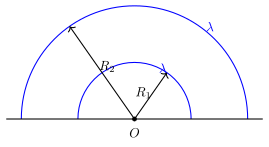
Two concentric upper semicircular half-rings of radii R1 and R2 with the same linear charge density lambda, sharing common centre O on the diameter line - For a half ring of radius R, every charge element is at distance R from centre O, so V=4πϵ0R1∫dq.
- Total charge on the half ring =λ×(πR) (length of a semicircular arc of radius R). …
🎓Unlock everything free for 10 days
- ✓Full step-by-step solutions
- ✓Concept-first explanations
- ✓Methods, shortcuts & mistakes
- ✓PYQ mapping + timed mock tests
Full access for 10 days. No credit card required.