Q.A capacitor has some dielectric between its plates and the capacitor is connected to a DC source. The battery is now disconnected and then the dielectric is removed. State whether the capacitance, the energy stored in it, electric field, charge stored and the voltage will increase, decrease or remain constant.
🔒You're viewing a preview — the full solution, concept, methods & PYQ mapping are locked.
🔒 Start your 10-day free trial to unlock the full solution →Concept understanding — Dielectric Insertion Capacitance
Dielectric Insertion Capacitance – From Intuition to Precision
Imagine you have two metal plates facing each other, separated by air. You connect them to a battery. The plates get charged — one positive, one negative — and they store energy in the electric field between them. That's a capacitor.
Now, without disconnecting the battery, you slide a slab of some insulating material (like glass, plastic, or mica) between the plates. What happens? The battery pushes more charge onto the plates. The capacitor now stores more charge for the same voltage. Its capacitance has increased.
That increase — the extra capacitance contributed by the presence of the dielectric — is what we call dielectric insertion capacitance.
The word "insertion" here simply means "the capacitance that appears because you inserted a dielectric." It's not a separate device; it's the change in capacitance due to the material.
Why does the capacitance increase?
The key is polarisation. Inside a dielectric, molecules are like tiny electric dipoles — they have a positive end and a negative end. In an electric field, these dipoles rotate to align with the field. The positive ends point toward the negative plate, and the negative ends point toward the positive plate.
This alignment creates a layer of bound charge on the surfaces of the dielectric, right next to the plates. This bound charge partially cancels the electric field inside the dielectric. But here's the crucial point: if the capacitor is connected to a battery (constant voltage), the battery responds by pushing more free charge onto the plates to restore the original field. More charge for the same voltage means higher capacitance.
If the capacitor is disconnected from the battery (constant charge), the dielectric reduces the voltage across the plates. Same charge, lower voltage — again, higher capacitance.
A common mistake: thinking the dielectric "creates" extra charge out of nothing. It doesn't. The battery supplies the extra charge in the constant-voltage case. In the constant-charge case, the voltage drops — the capacitance formula C=Q/V still gives a larger C because V is smaller.
The precise statement
Let’s define:
- C0 = capacitance of the capacitor with vacuum (or air) between the plates.
- κ (or εr) = dielectric constant (relative permittivity) of the material. For vacuum, κ=1. For most solids, κ>1 (e.g., glass ~5–10, water ~80).
When you fill the entire space between the plates with a dielectric of constant κ, the new capacitance is:
C=κC0
The dielectric insertion capacitance is the additional capacitance contributed by the dielectric:
Cinsertion=C−C0=(κ−1)C0
Cinsertion=(κ−1)C0
This is the extra capacitance you get purely because you inserted the dielectric. If κ=1 (vacuum), Cinsertion=0 — no insertion effect.
What if the dielectric only partially fills the gap?
In real problems, the slab might not fill the entire space. Then the capacitor behaves like two capacitors in series (or parallel, depending on geometry). The insertion capacitance is no longer a simple multiple — you have to compute the effective capacitance using the appropriate combination rules.
But the core idea remains: the dielectric increases capacitance because its polarisation reduces the net field (or, equivalently, allows more charge at the same voltage).
For a parallel-plate capacitor with plate area A, separation d, and a dielectric of thickness t inserted (leaving an air gap of d−t), the effective capacitance is:
C=d−t+κtε0A …
The key idea is that removing the dielectric (with the battery disconnected) keeps the charge constant (Q fixed), while the capacitance C drops because C∝κ (dielectric constant). All other quantities follow from Q=CV and U=2CQ2.
- Charge Q: With the battery disconnected, no path exists for charge to flow — Q remains constant.
- Capacitance C: C=dκϵ0A. Removing the dielectric reduces κ from >1 to 1 (air) → C decreases.
- Voltage V: From Q=CV, if Q is constant and C decreases, V=Q/C must increase. …
When the dielectric is removed after disconnecting the battery, the charge stays constant, capacitance decreases, voltage increases, electric field increases, and stored energy increases — because the system is isolated and work must be done to remove the polarised material.
The key to this problem is understanding when the battery is disconnected. If the battery stays connected, the voltage is fixed. But here, the battery is disconnected before the dielectric is removed. That changes everything.
Let’s walk through it step by step.
1. The initial situation — dielectric present, battery connected
A capacitor with a dielectric of constant K is connected to a DC source. The battery forces a fixed voltage V0 across the plates. The capacitance with the dielectric is:
C=KC0
where C0 is the capacitance with vacuum (or air) between the plates.
The charge stored is:
Q=CV0=KC0V0
The electric field inside the dielectric is E=V0/d, where d is the plate separation. The energy stored is:
U=21CV02=21KC0V02
All these values are set by the battery.
2. Battery is disconnected — charge is now trapped
When the battery is disconnected, the charge on the plates has no path to leave. So the charge Q becomes fixed — it cannot change, no matter what we do next.
A very common mistake is to think that removing the dielectric somehow lets charge leak away. It does not — the plates are isolated. The charge stays exactly the same.
So after disconnection:
- Charge stored: remains constant (same Q).
3. Dielectric is removed — what changes?
Now we pull out the dielectric slab. The material that was polarised and reducing the internal field is gone. The capacitance drops back to its vacuum value:
Cnew=C0
Since K>1, we have Cnew<C — capacitance decreases.
4. Voltage must adjust — because Q is fixed
The fundamental relation Q=CV still holds. Since Q is constant and C has decreased, the voltage must increase:
Vnew=C0Q=C0KC0V0=KV0
So voltage increases by a factor of K.
Think of it this way: with the dielectric, the polarised molecules partially cancel the field, so a smaller voltage is enough to hold the same charge. Remove the dielectric, and you need a larger voltage to maintain that same charge — hence V goes up.
5. Electric field — directly proportional to voltage
The electric field between parallel plates is E=V/d. Since d is fixed and V increases by factor K, the field also increases by factor K:
Enew=dVnew=dKV0=KE0
So electric field increases.
--- …
Method: Battery-Connected vs Battery-Disconnected Capacitor Problems
Use this method for ANY problem where a capacitor's dielectric, plate spacing, or plate area is changed either while a battery stays connected, or after the battery has been disconnected.
Steps
Step 1: Identify which quantity is held fixed
This is the single most important step. If the battery STAYS connected, the voltage V is fixed (the battery enforces it). If the battery is DISCONNECTED before the change, the charge Q is fixed (the isolated plates have nowhere for charge to go).
Step 2: Write the capacitance before and after the change
For a parallel-plate capacitor, C=dκε0A. Identify how κ (or A, or d) changes, and compute Cbefore and Cafter from the given geometry.
Step 3: Use Q=CV to find whichever quantity is NOT fixed
- If V is fixed (battery connected): Qnew=CnewV — charge changes.
- If Q is fixed (battery disconnected): Vnew=Q/Cnew — voltage changes. …
Showing the 12 most recent of 49 on this concept.
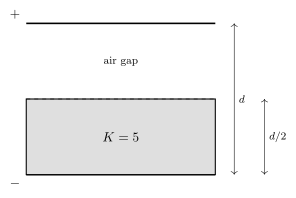
- JEE Main 2026Set 2026-04-02-s14 marksMCQQ.A parallel plate air capacitor has a capacitance C. When it is half filled as show in figure with a dielectric constant K = 5, the percentage increase in the capacitance is ________.
 (A) 33.34
(B) 66.67
(C) 200
(D) 400
›Reveal solutionSolution
Filling the lower half of the plate separation with a K=5 dielectric creates two capacitors in series (each with separation d/2); working out the series combination gives C′/C=2K/(K+1)=5/3, a 66.67% increase.
Parallel plate capacitor half-filled with dielectric of constant K=5 The key is recognising how the dielectric is inserted. Since it fills half the vertical gap between the plates (not half the plate area), the field a charge on the plate experiences passes first through air for a distance d/2 and then through the dielectric for another d/2 — electrically, that's two capacitors stacked in series, each carrying the same charge, each with the full plate area A but only half the separation.
- Capacitance of each half, treating it as a parallel-plate capacitor of separation d/2:
Cair=d/2ε0A=d2ε0A,Cdiel=d/2Kε0A=d2Kε0A
- Combine in series:
C′1=Cair1+Cdiel1=2ε0Ad(1+K1)=2ε0Ad⋅KK+1
C′=d(K+1)2Kε0A
For plates split along the separation (not the area) into two dielectric regions, the two halves act as capacitors in series: C′1=C11+C21. …
- JEE Main 2026Set 2026-01-21-s14 marksMCQQ.A parallel plate capacitor has capacitance C, when there is vacuum within the parallel plates. A sheet having thickness (1/3)rd of the separation between the plates and relative permittivity K is introduced between the plates. The new capacitance of the system is: (A) CK/(2+K) (B) 3KC/(2K+1) (C) 3KC²/(2K+1)² (D) 4KC/(3K−1)
›Reveal solutionSolution
Inserting a dielectric slab of thickness d/3 into a capacitor of gap d gives an effective gap d−t+t/K, leading to C′=2K+13KC.
Inserting a dielectric slab of thickness t is equivalent to shrinking the effective air gap, because the slab contributes only t/K of 'equivalent air thickness' instead of t.
C′=(d−t)+t/Kε0A …
- JEE Main 2026Set 2026-04-08-s24 marksQ.A parallel plate capacitor is having separation between plates 0.885 mm. It has a capacitance of 1 μF when the space between the plates is filled with an insulating material of resistivity 1 × 10¹³ Ωm and resistance 17.7 × 10¹⁴ Ω. Relative permittivity of the insulating material is α × 10⁷. The value of α is __________. (Take permittivity of free space = 8.85 × 10⁻¹² F/m)
›Reveal solutionSolution
Use the resistance formula to back out the plate area, then plug that area into the capacitance formula to solve for the relative permittivity.
- Resistance of the dielectric slab: R=Aρd ⇒ A=Rρd.
- A=17.7×10¹⁴(1×10¹³)(0.885×10⁻³)=17.7×10148.85×109=0.5×10−5=5×10⁻⁶m2.
- Capacitance: C=dεrε0A ⇒ εr=ε0ACd.
- Numerator: C⋅d=(1×10⁻⁶)(0.885×10⁻³)=8.85×10⁻¹⁰. …
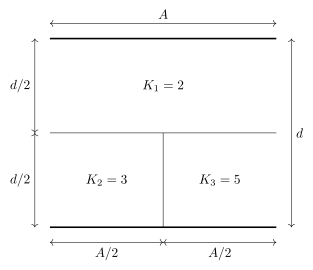
- JEE Main 2026Set 2026-01-23-s14 marksQ.The space between the plates of a parallel plate capacitor of capacitance C (without any dielectric) is now filled with three dielectric slabs of dielectric constants K₁ = 2, K₂ = 3 and K₃ = 5 (as shown in figure). If new capacitance is (n/3)C then the value of n is __________.
›Reveal solutionSolution
Split the capacitor into a top layer (full area, K1) in series with a bottom layer made of two side-by-side slabs (K2, K3) in parallel. Combine, then match to (n/3)C to get n=8.
Parallel plate capacitor with dielectric K1 filling the top half and K2, K3 side by side filling the bottom half Let C=dε0A be the original (no-dielectric) capacitance.
- Top half (thickness d/2, full area A, dielectric K1=2): treating it as its own parallel-plate capacitor,
C1=d/2K1ε0A=d2K1ε0A=2K1C=4C
- Bottom half: split into two slabs side by side, each of area A/2 and thickness d/2, holding K2=3 and K3=5 respectively. Since they share the same pair of plate halves and the same voltage, they act as two capacitors in parallel: …
- JEE Main 2026Set 2026-01-23-s24 marksMCQQ.A parallel plate capacitor with plate separation 5 mm is charged by a battery. On introducing a mica sheet of 2 mm and maintaining the connections of the plates with the terminals of the battery, it is found that it draws 25% more charge from the battery. The dielectric constant of mica is _____. (A) 1.5 (B) 2.0 (C) 1.0 (D) 2.5
›Reveal solutionSolution
Treating the partially-filled capacitor as two series capacitances and setting the new/old capacitance ratio to 1.25 (since charge rose 25% at fixed voltage) gives dielectric constant K=2.0.
Since the capacitor stays connected to the battery throughout, voltage V is fixed, so charge Q=CV is directly proportional to capacitance -- a 25% increase in charge means exactly a 25% increase in capacitance.
- Original capacitance (fully air-filled, separation d): C0 = epsilon0*A/d.
- With a dielectric slab of thickness t and constant K inserted (leaving an air gap of thickness d-t), the system behaves as two capacitors in series:
C_new = epsilon0*A / [(d-t) + t/K]
- The ratio C_new/C0 = d / [(d-t)+t/K] = 1.25 (25% more charge at the same voltage). …
- JEE Main 2026Set 2026-01-24-s24 marksMCQQ.Three parallel plate capacitors each with area A and separation d are filled with two dielectric (k1 and k2) in the following fashion. Which of the following is true? (k1 > k2) (A) CC > CA > CB (B) CC > CB > CA (C) CB > CC > CA (D) CA > CC > CB
›Reveal solutionSolution
Writing each capacitor as two half-area pieces in parallel (one a single full-thickness dielectric column, the other two half-thickness layers in series) and comparing algebraically gives C_A > C_C > C_B, since k₁ > k₂.
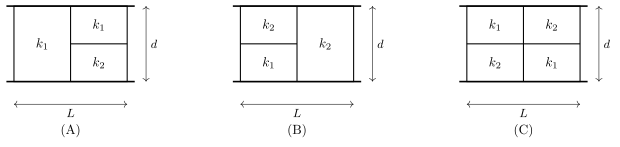
Three parallel plate capacitor configurations A, B, C showing different arrangements of dielectrics k1 and k2 as full-height columns and stacked half-thickness layers Step 1 — Set up the building blocks
Let C₀ = ε₀A/d (the capacitance of a full-area, full-separation, vacuum-filled capacitor). For a region of half the plate area (A/2):
- A full-column half filled with a single dielectric k (spanning the whole thickness d):
Ccol(k)=2kC0
- A layered half split into two d/2-thick layers of k_top, k_bot (in series, since the same field line crosses both in sequence):
Clayer(ktop,kbot)=C0⋅ktop+kbotktopkbot≡S,S=k1+k2k1k2C0 (same value regardless of layer order)
The left half and right half of each capacitor share the same two plates, so they combine in parallel: C_total = C_left + C_right.
Step 2 — Apply to each configuration
- (A): left = full column of k₁, right = layered (k₁ over k₂): CA=2k1C0+S …
- JEE Main 2026Set 2026-01-28-s24 marksMCQQ.Identify the correct statements : A. Effective capacitance of a series combination of capacitors is always smaller than the smallest capacitance of the capacitor in the combination. B. When a dielectric medium is placed between the charged plates of a capacitor, displacement of charges cannot occur due to insulation property of dielectric. C. Increasing of area of capacitor plate or decreasing of thickness of dielectric is an alternate method to increase the capacitance. D. For a point charge, concentric spherical shells centered at the location of the charge are equipotential surfaces. Choose the correct answer from the options given below : (A) C and D Only (B) A, C and D Only (C) A, B and C Only (D) B and D Only
›Reveal solutionSolution
A, C, and D are standard, correct capacitor/field facts; B is false because a dielectric's bound charges do get displaced (polarized) under an applied field — insulators block free-charge flow, not internal charge displacement.
- (A) True. For capacitors in series, Ceff1=C11+C21+⋯, which always makes Ceff smaller than the smallest individual Ci (analogous to resistors in parallel).
- (B) False. A dielectric is an insulator in the sense that it blocks the flow of free (conduction) charge — but under an applied electric field, its bound charges absolutely do get displaced at the molecular level (electron clouds shift, or polar molecules align), which is exactly the phenomenon of polarization. This displacement of bound charge is what creates the dielectric's opposing field and increases the capacitor's capacitance. Claiming it "cannot occur" directly contradicts the mechanism by which a dielectric works.
Parallel-plate capacitance: C=dε0εrA …
- JEE Main 2025Set 2025-01-24-s14 marksMCQQ.A parallel plate capacitor was made with two rectangular plates, each with a length of l = 3 cm and breadth of b = 1 cm. The distance between the plates is 3μm. Out of the following, which are the ways to increase the capacitance by a factor of 10 ? A. l = 30 cm, b = 1 cm, d = 1μm B. l = 3 cm, b = 1 cm, d = 30μm C. l = 6 cm, b = 5 cm, d = 3μm D. l = 1 cm, b = 1 cm, d = 10μm E. l = 5 cm, b = 2 cm, d = 1μm Choose the correct answer from the options given below: (A) C only (B) A only (C) B and D only (D) C and E only
›Reveal solutionSolution
Computing (l′b′)/d′ for each option and comparing to 10 times the original value shows only options C and E achieve exactly a 10x increase in capacitance.
Since C=ε0lb/d for a parallel plate capacitor, any combination of length, breadth, and separation that makes the ratio lb/d ten times its original value will give exactly ten times the capacitance — regardless of which individual dimension changed. This turns a seemingly complicated multi-option question into a simple ratio check for each case.
- Original dimensions: l=3 cm, b=1 cm, d=3μm, so the baseline ratio is dlb=33×1=1 (in consistent units of cm²/μm).
- We need the new ratio d′l′b′=10×1=10 for a tenfold capacitance increase. …
- JEE Main 2025Set 2025-01-22-s14 marksMCQQ.A parallel-plate capacitor of capacitance 40μF is connected to a 100 V power supply. Now the intermediate space between the plates is filled with a dielectric material of dielectric constant K = 2. Due to the introduction of dielectric material, the extra charge and the change in the electrostatic energy in the capacitor, respectively, are (A) 8 mC and 2.0 J (B) 4 mC and 0.2 J (C) 2 mC and 0.2 J (D) 2 mC and 0.4 J
›Reveal solutionSolution
With the capacitor kept connected to the 100 V supply throughout, inserting the K=2 dielectric doubles the capacitance; since Q=CV and U=21CV2 at fixed V, both the charge and the stored energy also double, giving an extra 4 mC of charge and an extra 0.2 J of energy.
Intuition. The key fact that decides this whole problem is that the capacitor stays wired to the battery (constant V) rather than being isolated (constant Q). At fixed voltage, both charge and energy track the capacitance directly and linearly/quadratically, so doubling C straightforwardly doubles Q and doubles U — there's no need to worry about charge redistribution or energy loss to the battery in computing the changes themselves (those final-state quantities are computed directly from C′,V).
1. Before inserting the dielectric.
C0=40 μF,V=100 V
Q0=C0V=40×10−6×100=4×10⁻³ C=4 mC
U0=21C0V2=21(40×10−6)(100)2=21(0.4)=0.2 J
2. After inserting the dielectric (K=2, battery still connected so V unchanged):
C′=KC0=2×40=80 μF …
- JEE Main 2025Set 2025-04-02-s24 marksMCQQ.Two large plane parallel conducting plates are kept 10 cm apart as shown in figure. The potential difference between them is V. The potential difference between the points A and B (shown in the figure) is : (A) 1 V (B) 1/4 V (C) 3/4 V (D) 2/5 V
›Reveal solutionSolution
VA−VB=52V — option (D).
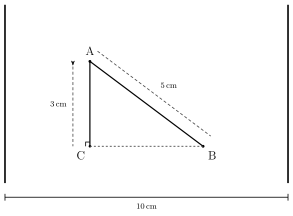
Two parallel conducting plates 10 cm apart with a right triangle A, C, B between them; AC = 3 cm, AB = 5 cm Intuition: between two large parallel plates the field, and hence the potential, is uniform and varies only along the direction perpendicular to the plates (the horizontal direction here). Any two points with the same horizontal coordinate are automatically at the same potential, no matter their vertical separation.
- Let d=10 cm be the plate separation and E=V/d the (uniform, horizontal) field magnitude between them.
- Triangle ACB is right-angled at C, with AC=3 cm (vertical) and hypotenuse AB=5 cm. By Pythagoras, CB=AB2−AC2=25−9=4 cm, and CB is horizontal (since C,B lie on a common horizontal line). …
- JEE Main 2025Set 2025-04-03-s14 marksMCQQ.A parallel plate capacitor is filled equally(half) with two dielectrics of dielectric constants ε1 and ε2, as shown in figures. The distance between the plates is d and area of each plate is A. If capacitance in first configuration and second configuration are C1 and C2 respectively, then C1/C2 is: First Configuration: [see figure] Second Configuration: [see figure] (A) ε0(ε1+ε2)/2 (B) ε1·ε2²/(ε1+ε2)² (C) 4ε1ε2/(ε1+ε2)² (D) ε1ε2/(ε1+ε2)
›Reveal solutionSolution
C1 (series stack) and C2 (parallel halves) combine to give C1/C2 = 4ε1ε2/(ε1+ε2)².
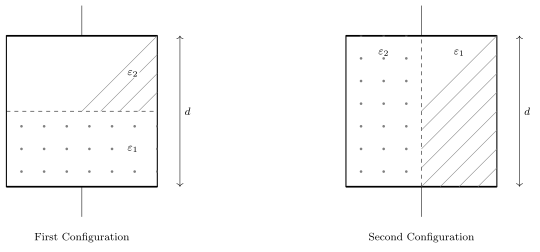
Parallel plate capacitor with two dielectrics: first configuration layered in series (half the plate separation each), second configuration side by side in parallel (half the plate area each) - First configuration (each dielectric fills half the plate separation, full area A — a series stack along the field): individual capacitances C_a = 2ε₀ε1A/d, C_b = 2ε₀ε2A/d. In series:
1/C1 = 1/C_a + 1/C_b = (d/2ε₀A)(1/ε1 + 1/ε2) ⇒ C1 = (2ε₀A/d)·ε1ε2/(ε1+ε2) …
- JEE Main 2025Set 2025-04-04-s24 marksMCQQ.Three parallel plate capacitors C₁, C₂ and C₃ each of capacitance 5μF are connected as shown in figure. The effective capacitance between points A and B, when the space between the parallel plates of C₁ capacitor is filled with a dielectric medium having dielectric constant of 4, is : (A) 9μF (B) 30μF (C) 7.5μF (D) 22.5μF
›Reveal solutionSolution
The dielectric only affects C1, raising it to 20μF; combining the top series pair and adding the bottom branch in parallel gives 9μF.
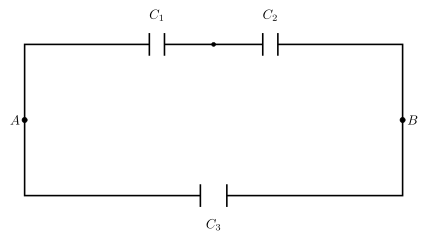
C1 and C2 in series on the top branch between A and B, with C3 alone on a parallel bottom branch The circuit has two parallel paths between A and B: the top path is C1 and C2 in series, the bottom path is C3 alone. Only C1 gets the dielectric.
- New value of C1: C1′=kC1=4×5=20μF. C2=5μF unchanged. …
🎓Unlock everything free for 10 days
- ✓Full step-by-step solutions
- ✓Concept-first explanations
- ✓Methods, shortcuts & mistakes
- ✓PYQ mapping + timed mock tests
Full access for 10 days. No credit card required.