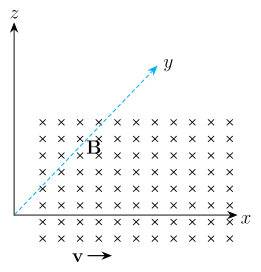
Q.If the magnetic field is parallel to the positive -axis and the charged particle is moving along the positive -axis (Fig. 4.4), which way would the Lorentz force be for
You're viewing a preview — the full solution, concept, methods & PYQ mapping are locked.
Start your 14-day free trial to unlock the full solution →The Lorentz force direction is given by . For a proton (positive ), the force is along ; for an electron (negative ), the force is along .
The core idea here is the direction of the Lorentz force, set by the cross product together with the sign of the charge. The Lorentz force law tells us that a charged particle moving in a magnetic field experiences a force perpendicular to both its velocity and the field. This perpendicular nature is what makes magnetic forces so elegant (and tricky): they never speed up or slow down a particle, only bend its path.
For this problem, we have:
- along (positive y-axis)
- along (positive x-axis)
- Two cases: (proton) and (electron)
The right-hand rule (or the cross product) gives the direction of , and then the sign of decides whether the force is along that direction or opposite to it.
-
Find the direction of
Using the right-hand rule: point fingers along (positive ), curl them toward (positive ). Your thumb points along (upward).
Mathematically: , so points along .
-
Apply the Lorentz force law
The force is .
- For a proton (): , so the force is along .
- For an electron (): , so the force is along . …
Unlock everything free for 14 days
- Full step-by-step solutions
- Concept-first explanations
- Methods, shortcuts & mistakes
- PYQ mapping + timed mock tests
Full access for 14 days. No credit card required.