Q.A straight wire of mass and length carries a current of . It is suspended in mid-air by a uniform horizontal magnetic field (Fig. 4.3). What is the magnitude of the magnetic field?
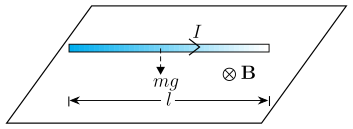
The wire is suspended in mid-air, so the upward magnetic force exactly balances its weight. Using and , we get .
The key insight here is that "suspended in mid-air" means the wire is in equilibrium — it isn't accelerating up or down. That tells us the net vertical force on it is zero. The only two vertical forces are its weight (downward) and the magnetic force from the field (upward). So this is a straightforward force balance problem.
Why does the magnetic force point upward? The current is horizontal (to the right, as shown in the figure), and the magnetic field is uniform and directed into the page (indicated by the symbol). Using the right-hand rule for a current-carrying wire in a magnetic field — point your fingers in the direction of the field (into the page), your thumb in the direction of current (right), and your palm gives the direction of force — you get an upward force. That's exactly what we need to oppose gravity.
Now let's work through the numbers.
-
Write down the known quantities.
Mass (always convert to SI units).
Length .
Current .
Acceleration due to gravity (standard value unless specified otherwise).
-
Write the force balance equation.
Magnetic force on a straight wire in a uniform perpendicular field: .
Weight: .
For equilibrium: , so
- Solve for .
- Plug in the numbers.
A common mistake is to forget converting grams to kilograms. Using directly gives , which is absurdly large and would instantly vaporise the wire. Always check units.
Notice that the length of the wire cancels out of the force balance only if the field is uniform over the entire wire. That's why the problem explicitly says "uniform horizontal magnetic field" — it ensures the simple formula applies.
The magnitude of the magnetic field is (rounded to two decimal places).
Unlock everything free for 14 days
- Full step-by-step solutions
- Concept-first explanations
- Methods, shortcuts & mistakes
- PYQ mapping + timed mock tests
Full access for 14 days. No credit card required.