Question 14 of 29
Q.(a) Draw the structure of leaf and mark the parts.
(b) Draw the structure of pulvinus leaf base and sheathing leaf base.
Tamil Nadu DgeTamil Nadu HSC First Year (DGE) Board 2019Subjective· 3mImportance★★★★★
48% · 14/29 Questions
You're viewing a preview — the full solution, concept, methods & PYQ mapping are locked.
Start your 14-day free trial to unlock the full solution →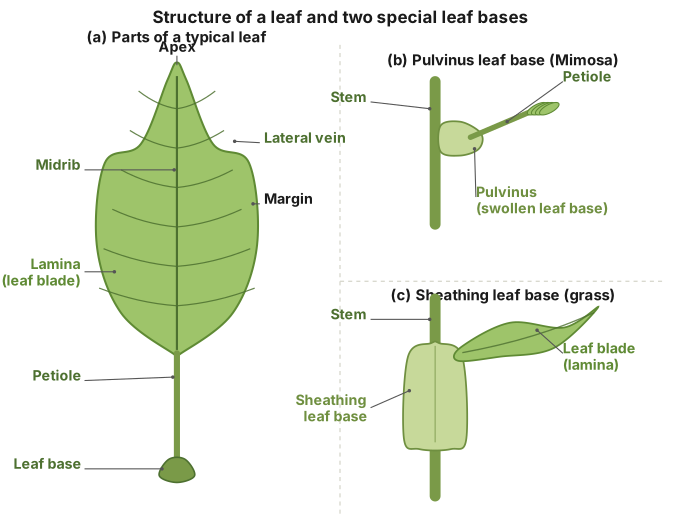
A typical leaf is made of leaf base, petiole and lamina; a pulvinus leaf base is swollen and cushion-like (enabling movement, as in Mimosa), while a sheathing leaf base wraps around the stem like a sheath (as in grasses) — described here since a hand-drawn diagram cannot be produced in text.
(a) Structure of a leaf and its parts:
A typical dorsiventral leaf consists of three main parts:
- Leaf base — the region where the leaf attaches to the stem at the node; may bear a pair of lateral outgrowths called stipules.
- Petiole — the stalk of the leaf that holds the lamina (blade) out to the light and allows it to move/flutter in air currents.
- Lamina (leaf blade) — the flat, expanded green part of the leaf, containing:
- Midrib — the prominent central vein running from base to apex.
- Veins and veinlets — the branching vascular network (venation) arising from the midrib, either reticulate (net-like, in dicots) or parallel (in monocots).
- Margin — the outer edge of the lamina, which may be entire, serrate, dentate, etc.
- Apex — the tip of the lamina.
(b) Pulvinus and sheathing leaf bases (two special modifications of the leaf base):
- Pulvinus leaf base — the leaf base becomes swollen, cushion-like, and pulvinated; it is filled with motor cells whose turgor changes allow rapid or slow movement of the leaf/leaflets. Classic example: Mimosa pudica (touch-me-not), where the pulvinus enables the leaflets to fold rapidly on touch (seismonasty), and many legumes show pulvini enabling daily 'sleep movements' (nyctinasty). …
Unlock everything free for 14 days
- Full step-by-step solutions
- Concept-first explanations
- Methods, shortcuts & mistakes
- PYQ mapping + timed mock tests
Full access for 14 days. No credit card required.