Q.An object of mass m is held at rest against a vertical wall by pressing it with a horizontal force F, as shown in the figure.
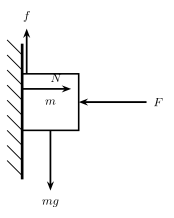
Concept understanding — Static Friction Limit
The Static Friction Limit: Why a Heavy Box Won't Move Until You Really Push
Imagine you're trying to push a heavy wooden crate across a rough floor. You lean into it gently — nothing happens. You push a little harder — still nothing. The crate stays perfectly still, as if glued to the spot. Then, at some point, you push just a bit more, and suddenly the crate lurches forward.
That invisible "sticking point" — the exact moment the crate finally gives way — is the static friction limit.
The Intuition: Friction as a "Smart" Force
Friction between two surfaces that aren't sliding is called static friction. What makes it special is that it's self-adjusting. It doesn't have a fixed value. Instead, it automatically grows to match whatever force you apply — up to a point.
Think of it like a tug-of-war where your opponent (static friction) matches your pull exactly, but only until you exceed their maximum strength. As long as you pull less than their limit, you both stay in equilibrium and nothing moves. The moment you exceed that limit, you win — and the crate starts sliding.
Static friction only exists when there is no relative motion between the surfaces. Once sliding begins, it's replaced by kinetic friction, which is usually weaker.
The Precise Statement
The static friction limit (also called limiting friction) is the maximum possible value of static friction that can act between two surfaces in contact before they start sliding relative to each other.
Mathematically:
fs≤μsN
Where:
- fs = static friction force (the actual value, which can be anything from 0 up to the limit)
- μs = coefficient of static friction (a constant that depends on the two materials — rubber on concrete is high, ice on steel is low)
- N = normal reaction force (the force pressing the surfaces together, usually equal to weight on a horizontal surface)
The static friction limit is the equality case:
fs,max=μsN
This is the maximum static friction the surfaces can provide. Apply a force less than this, and the object stays put. Apply a force equal to this, and the object is on the verge of moving (impending motion). Apply a force greater than this, and the object accelerates.
A Concrete Example
A 10 kg block rests on a horizontal floor. μs=0.4 between the block and floor. Take g=10 m/s2.
Normal reaction: N=mg=10×10=100 N
Static friction limit: fs,max=0.4×100=40 N
Now, what happens as you push?
| Applied Force | Static Friction | Result |
|---|---|---|
| 10 N | 10 N (matches) | Block stays still |
| 25 N | 25 N (matches) | Block stays still |
| 40 N | 40 N (matches) | Block is just about to move |
| 45 N | 40 N (cannot exceed limit) | Block accelerates forward |
A common mistake is to think static friction is always equal to μsN. It is not. The formula μsN gives only the maximum possible value. The actual static friction is whatever is needed to prevent motion, up to that maximum.
Why This Matters
The static friction limit explains countless everyday phenomena:
- Why you can lean a ladder against a wall without it sliding (static friction at the base holds it)
- Why car brakes work better before the wheels lock (static friction between tyre and road is higher than kinetic friction)
- Why it's harder to start pushing a heavy object than to keep it moving (static friction limit > kinetic friction)
The key takeaway: Static friction is a variable force with a fixed ceiling. That ceiling — the static friction limit — is determined by how rough the surfaces are (μs) and how hard they're pressed together (N).
If you landed here looking for "Static Friction Limit formula" or "Static Friction Limit numericals class 11", it helps to know that Static Friction Limit is a core, NCERT-aligned topic from the Laws of Motion portion of the Class 11 Physics curriculum, and it is tested regularly in CBSE board exams as well as in JEE Main and NEET. Revisiting the NCERT Physics textbook exercises for this chapter alongside the walkthrough above is a solid way to convert this into exam-ready practice.
For the block to stay up, friction (which is at most μF) must support its weight mg.
(c) Greater than mg — since Fmin=mg/μ and μ is typically less than 1, Fmin>mg.
Step 1. Two forces act horizontally/vertically on the block: the applied force F (horizontal) and the wall's normal reaction N=F; vertically, gravity mg acts down and static friction fs≤μN=μF acts up.
Step 2. For the block to remain at rest (not slide down), friction must supply the full weight: fs=mg, and this requires μF≥mg.
Step 3. The minimum force is therefore Fmin=μmg.
Step 4. Since the coefficient of friction μ is, for essentially all real surface pairs, a fraction less than 1, Fmin=mg/μ is necessarily greater than mg.
(c) Greater than mg.
Balance the horizontal (N=F) and vertical (friction supports mg) directions, then note μ<1 forces F_min>mg.
- Assuming the answer needs a numeric μ, rather than recognising the general inequality mg/μ > mg holds whenever μ<1.
- Forgetting that the normal force here comes from the applied F itself (horizontal), not from gravity.
Showing the 12 most recent of 31 on this concept.
- CBSE 2026Set ANNUAL1 markMCQQ.Which of the following is the greatest?(a) Static friction(b) Kinetic friction(c) Rolling friction(d) Fluid friction
›Reveal solutionSolution
Experimentally, (limiting) static friction > kinetic friction > rolling friction, and fluid friction is generally the smallest of all for comparable conditions.
Friction between two solid surfaces has three regimes: static friction (opposes the start of relative sliding, up to a maximum/limiting value), kinetic friction (opposes actual sliding, once motion has started), and rolling friction (opposes rolling motion, arising mainly from small deformation at the contact patch). Experimentally:
fstatic, max>fkinetic>frolling
— this is exactly why it's harder to START pushing a heavy box than to keep it sliding, and why wheels/ball-bearings are used to reduce friction further by converting sliding into rolling contact. Fluid friction (viscous drag from a liquid or gas) is typically much weaker than solid-surface friction under comparable everyday conditions, since fluids offer far less resistance to relative motion than solid-on-solid contact.
So, among the four listed, static friction is the greatest.
✓Final answer(a) Static friction.
- CBSE 2026Set ANNUAL1 markQ.By using ball bearings, sliding friction can be converted into ............. friction.
›Reveal solutionSolution
Ball bearings replace sliding contact with rolling contact, and rolling friction is much lower than sliding (kinetic) friction.
When two surfaces slide directly against each other, they experience sliding (kinetic) friction, which is relatively large because of interlocking surface irregularities scraping past one another. Ball bearings are small hard spheres placed between two surfaces (e.g. inside a wheel's axle housing) so that, instead of sliding, the surfaces roll over the balls. Rolling friction is much smaller than sliding friction because the contact area deforms only slightly and there is far less relative scraping motion at the contact points. This is why machines, wheels, and axles use ball (or roller) bearings — to convert a large sliding-friction loss into a much smaller rolling-friction loss.
✓Final answerSliding friction is converted into rolling friction, which is much smaller — this is why ball bearings are used to reduce frictional losses in machinery.
- CBSE 2026Set ANNUAL1 markQ.Define coefficient of friction. OR Define angle of friction.
›Reveal solutionSolution
μ=f/N: the coefficient of friction is how many times larger the maximum frictional force is compared to the normal (perpendicular) contact force.
When two surfaces are in contact and one tends to slide (or slides) over the other, a frictional force f opposes this relative motion, and it is found experimentally to be directly proportional to the normal reaction force N pressing the two surfaces together:
f=μN
The constant of proportionality μ is called the coefficient of friction:
μ=Nf
It is a dimensionless number depending on the nature (roughness, material) of the two surfaces in contact — not on the apparent area of contact or (to a good approximation) the normal force's magnitude itself. μs (coefficient of static/limiting friction) is usually slightly larger than μk (coefficient of kinetic friction) for the same pair of surfaces.
✓Final answerμ=Nflimiting — the coefficient of friction is the ratio of limiting friction to the normal reaction between the two surfaces.
- CBSE 2026Set ANNUAL1 markMCQQ.Match the column - select the correct definition (from Column B) for the term 'Friction' (Column A):(a) change in linear momentum(b) motion opposing force(c) loss of energy(d) rate of change of momentum(e) ability of doing work(f) rate of doing work
›Reveal solutionSolution
Friction is the force that opposes relative motion between contacting surfaces.
Friction arises at the point of contact between two surfaces and always acts in a direction that opposes the relative sliding motion (kinetic friction) or the tendency toward such motion (static friction) between the surfaces. It never aids motion; its defining role is to resist it. This matches column B option (b), 'motion opposing force'.
✓Final answerFriction (Column A) matches (b) motion opposing force (Column B).
- CBSE 2026Set ANNUAL1 markQ.Write the answer in one word/one sentence: Write the dimensional formula for coefficient of friction mu.
›Reveal solutionSolution
Coefficient of friction has no dimensions — it is a pure (dimensionless) number.
The coefficient of friction is defined as:
μ = f / N
where f is the frictional force and N is the normal reaction, both measured in newtons (dimensions [M L T⁻²]). Since μ is the ratio of two quantities with identical dimensions, all dimensions cancel:
μ = [M L T⁻²] / [M L T⁻²] = [M⁰ L⁰ T⁰]
This is why μ is expressed as a pure number (e.g., μ = 0.3 for many dry surface pairs) with no attached unit.
✓Final answerDimensional formula of μ = [M⁰ L⁰ T⁰] (dimensionless).
- CBSE 2025Set ANNUAL1 markMCQQ.If normal force is doubled then coefficient of friction will be (A) doubled (B) four times (C) equal (D) half
›Reveal solutionSolution
The coefficient of friction μ does not depend on the normal force; it stays the same when N is doubled.
The friction force is related to the normal reaction by:
f=μN
Here μ, the coefficient of friction, depends only on the nature and roughness of the two surfaces in contact — it is a material property, not a function of N. If N is doubled, the friction force f also doubles proportionally, but the ratio μ=f/N stays exactly the same.
✓Final answer(C) equal.
- CBSE 2025Set ANNUAL1 markMCQQ.Which frictional force is the lowest?(a) Sliding friction(b) Rolling friction(c) Static friction(d) Both (A) and (B)
›Reveal solutionSolution
The general ordering of friction magnitudes (for the same pair of surfaces) is: static friction > sliding (kinetic) friction > rolling friction -- so rolling friction is the lowest.
Static friction: opposes the start of relative motion; its maximum value is usually the largest of the three.
Sliding (kinetic) friction: acts once surfaces are sliding over each other; smaller than maximum static friction.
Rolling friction: acts when a body rolls (like a wheel) instead of sliding; because a rolling body's contact point is nearly stationary relative to the surface at each instant, rolling friction is far smaller than both static and sliding friction. This is why wheels are used to move heavy loads instead of dragging them.
✓Final answer(b) Rolling friction.
- CBSE 2025Set ANNUAL1 markMCQQ.The coefficient of friction between the tyres and road is 0.1. The maximum speed with which a cyclist can take a circular turn of radius 3 m without skidding is (Take g = 10 ms^-2)(a) sqrt(15) ms^-1(b) sqrt(3) ms^-1(c) sqrt(30) ms^-1(d) sqrt(10) ms^-1
›Reveal solutionSolution
For a cyclist taking a flat circular turn, friction alone supplies the centripetal force; equating them gives v_max = sqrt(mu g r) = sqrt(3) m/s.
On a flat (unbanked) circular road, the maximum speed without skidding is set by the condition that the required centripetal force does not exceed the maximum available friction force:
(m v^2) / r <= mu * m * g
v_max = sqrt(mu * g * r)
Substituting mu = 0.1, g = 10 m/s^2, r = 3 m:
v_max = sqrt(0.1 x 10 x 3) = sqrt(3) m/s.
✓Final answer(b) sqrt(3) ms^-1.
- CBSE 2025Set ANNUAL1 markMCQQ.Match the following - Column A item: Coefficient of friction. Pick the matching relation from Column B.(a) F.V (Force . Velocity)(b) T is proportional to sqrt(l)(c) eta is proportional to 1/(dv/dx)(d) mu_s = tan(theta)(e) Y is proportional to 1/l(f) v^2/r
›Reveal solutionSolution
Coefficient of friction (mu_s) is related to the angle of friction/repose theta by mu_s = tan(theta).
When a body rests on an inclined surface, it is on the verge of sliding when the angle of incline equals the angle of friction theta, at which point the maximum static friction force just balances the component of gravity along the incline. This condition gives mu_s = tan(theta) — the standard defining relation for the coefficient of (static) friction in terms of the angle of repose.
✓Final answerCoefficient of friction matches option (d): mu_s = tan(theta).
- CBSE 2025Set sz1 markMCQQ.The maximum value of static friction when the body is at the verge of starting motion is known as: (A) Impending motion (B) Angle of repose (C) Static friction (D) Limiting friction
›Reveal solutionSolution
The maximum static friction, reached at the verge of motion, is called limiting friction.
Static friction adjusts itself to balance the applied force and can take any value up to a maximum.
The instant the body is on the verge of sliding, static friction attains this maximum value, known as limiting friction (fsmax=μsN).
(Angle of repose is a related angle, and static/impending motion are not the name of this maximum value.)
✓Final answerThe correct option is (D) Limiting friction.
- CBSE 2024Set ANNUAL1 markMCQQ.If normal reaction becomes double then coefficient of friction will be (A) doubled (B) four times (C) equal (D) halved
›Reveal solutionSolution
Doubling the normal reaction leaves μ unchanged; only the friction force doubles.
The coefficient of friction is defined by f=μN, i.e. μ=f/N. It depends only on the nature and roughness of the two surfaces in contact, not on the magnitude of the normal reaction. If N is doubled, the friction force f=μN also doubles proportionally, keeping the ratio μ exactly the same.
✓Final answer(C) equal (remains unchanged).
- CBSE 2024Set SET-NDP60001 markMCQQ.The maximum value of static friction is called:(a) Rolling friction(b) Kinetic friction(c) Limiting friction(d) None of the above
›Reveal solutionSolution
The maximum value of static friction, reached just before sliding begins, is called limiting friction.
When an applied force tries to slide one surface over another, static friction adjusts itself to exactly balance the applied force, up to a maximum value. Below this maximum, the body stays at rest (static friction is self-adjusting). Once the applied force exceeds this maximum, the body starts to slide, and friction drops to (and stays close to) kinetic friction. This maximum value of static friction — the threshold value just before motion begins — is called limiting friction, fs,max=μsN, where μs is the coefficient of static friction and N is the normal reaction. Kinetic friction (option b) acts only once sliding has already started, and is generally slightly less than limiting friction; rolling friction (option a) is a different, much smaller effect that resists rolling motion.
✓Final answerThe correct option is (c) Limiting friction.
🎓Unlock everything free for 14 days
- ✓Full step-by-step solutions
- ✓Concept-first explanations
- ✓Methods, shortcuts & mistakes
- ✓PYQ mapping + timed mock tests
Full access for 14 days. No credit card required.