Q.Using free body diagram, show that whether it is easy to pull an object than to push it.
You're viewing a preview — the full solution, concept, methods & PYQ mapping are locked.
Start your 14-day free trial to unlock the full solution →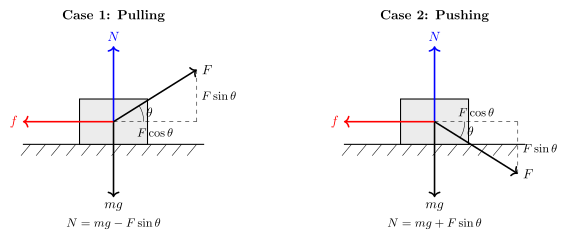
Both pulling and pushing an object apply a force at some angle θ to the horizontal, but the VERTICAL component of that force acts in opposite senses in the two cases — reducing the normal force (and friction) when pulling, and increasing it when pushing. Since friction directly resists motion, pulling needs less applied force than pushing to move the same object.
Case 1 — Pulling the object:
A force F is applied at angle θ above the horizontal, pulling the block. Draw the free body diagram of the block: weight mg acts downward; normal reaction N acts upward; the applied force F has a horizontal component F cosθ (forward, causing motion) and a vertical component F sinθ (upward, since the pull is angled upward).
Balancing vertical forces (block stays on the ground, no vertical acceleration):
N + F sinθ = mg
N = mg − F sinθ
Since F sinθ is subtracted, the normal reaction N is REDUCED compared to the object simply resting under its own weight.
Frictional force opposing motion: f = μN = μ(mg − F sinθ) — this is SMALLER than μmg.
Case 2 — Pushing the object:
A force F is applied at angle θ BELOW the horizontal (pushing down and forward, as one naturally pushes an object from above/behind). Its horizontal component F cosθ drives the block forward, and its vertical component F sinθ now acts DOWNWARD (adding to the weight, since the push is angled into the ground).
…
Unlock everything free for 14 days
- Full step-by-step solutions
- Concept-first explanations
- Methods, shortcuts & mistakes
- PYQ mapping + timed mock tests
Full access for 14 days. No credit card required.