Tension in Connected Bodies – A First Look
Imagine you and a friend are pulling a heavy box across the floor using a single rope between you. You pull one end, your friend pulls the other. The rope goes taut. What do you feel in your hands? A pull — that's tension. Now imagine the box is on a frictionless surface and you pull harder. The rope stays taut, the box accelerates, and the pull you feel is still there, but now it's doing something more: it's transmitting your force to the box.
That's the core idea. Tension is the internal force that runs through a string, rope, or cable when it is stretched. In problems with connected bodies, the string links two or more masses together, and the tension force is the same at every point along a massless, inextensible string. It pulls equally on both ends — on each body it acts along the string, toward the string's centre.
For a massless, inextensible string, tension is uniform throughout its length. That means the magnitude of the force on mass A is exactly the same as the magnitude of the force on mass B.
Why does tension exist?
When you pull one end of a string, the string stretches microscopically. The molecules resist being pulled apart, and that resistance is what we call tension. In ideal physics problems, we ignore the stretch and the mass of the string itself. That simplification lets us say: the string is just a perfect force transmitter — it takes the force from one body and delivers it unchanged to the other.
The key step: Isolate each body
To find the tension, you cannot just look at the whole system. You must apply Newton's second law (F=ma) to each body separately. Draw a free-body diagram for each mass. On each diagram, the tension force appears as an arrow pointing away from the body along the string (because the string pulls inward on each mass).
Here is the general procedure:
- Identify all bodies connected by the string.
- Assume the string is taut and inextensible — all bodies move with the same acceleration magnitude.
- Choose a direction of motion (positive direction) for the whole system.
- For each body, write Fnet=ma, including tension as one of the forces.
- Solve the equations simultaneously.
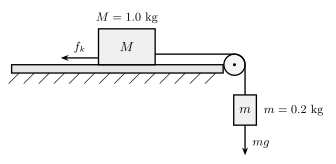
If the string passes over a frictionless, massless pulley, the tension is the same on both sides of the pulley. The pulley only changes the direction of the tension force, not its magnitude.
A simple example to make it concrete
Consider two blocks on a frictionless horizontal surface. Block A (mass m1) is tied by a string to block B (mass m2). You pull block B with a horizontal force F.
- On block A: the only horizontal force is tension T pulling it forward. So T=m1a.
- On block B: the horizontal forces are F forward and T backward. So F−T=m2a.
Since the string is inextensible, both blocks have the same acceleration a. Add the two equations:
T+(F−T)=m1a+m2a⇒F=(m1+m2)a
So a=m1+m2F. Then from T=m1a, you get:
T=m1+m2m1F
Notice: tension is not equal to the applied force F. It is only a fraction of it, determined by the mass ratio. If m1 is very small, tension is small — the string barely pulls the light block. If m1 is huge, tension is nearly F — the heavy block resists acceleration, so the string must pull hard.
A common mistake is to think tension equals the applied force. It does not. Tension is whatever force is needed to accelerate the other block at the same rate as the whole system.
What about vertical motion? (Atwood machine) …