Question 27 of 36
Q.Explain the function of superheterodyne AM receiver with block diagram.
Tamil Nadu DgeTamil Nadu HSC (DGE) Board 2018Subjective· 10mImportance★★★★★
75% · 27/36 Questions
You're viewing a preview — the full solution, concept, methods & PYQ mapping are locked.
Start your 14-day free trial to unlock the full solution →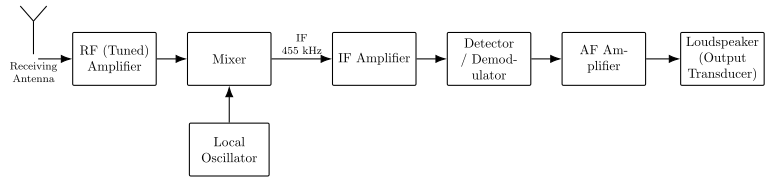
A superheterodyne AM receiver converts every received station's radio-frequency (RF) signal to one fixed intermediate frequency (IF) using a mixer and local oscillator, so that a single, optimally designed IF amplifier can provide uniform selectivity and sensitivity for any station, before the signal is demodulated and amplified for the loudspeaker.
Block diagram (stages, in order)
Receiving Antenna → RF Amplifier (tuned) → Mixer ← Local Oscillator → IF Amplifier → Detector (Demodulator) → AF Amplifier → Loudspeaker
Function of each block
- Receiving antenna: intercepts electromagnetic radio waves of many stations/frequencies simultaneously and converts them into a very weak mixture of RF electrical signals.
- RF amplifier (tuner): a tuned circuit selects the desired station's carrier frequency from the mixture (rejecting others) and amplifies this weak RF signal.
- Local oscillator: generates a continuous sinusoidal signal of frequency that is ganged (mechanically/electrically linked) to the RF tuning, such that it always stays a fixed amount above the selected station frequency: .
- Mixer (frequency changer): combines (heterodynes) the amplified RF signal () with the local-oscillator signal (). Mixing two frequencies produces output components at the sum () and difference () frequencies (among others); a tuned circuit in the mixer output selects only the difference frequency, which is a fixed value (standard for AM broadcast) regardless of which station is tuned in, because tracks automatically.
- IF amplifier: amplifies this fixed-frequency IF signal. Because the frequency is always the same, the IF amplifier's tuned circuits can be permanently and precisely designed for maximum gain and the correct bandwidth (selectivity), giving the receiver uniformly good performance at every tuned station — this is the central advantage of the superheterodyne principle over a simple tuned-radio-frequency (TRF) receiver. …
Unlock everything free for 14 days
- Full step-by-step solutions
- Concept-first explanations
- Methods, shortcuts & mistakes
- PYQ mapping + timed mock tests
Full access for 14 days. No credit card required.