Q.Draw a neat sketch of Ruby Laser. Explain its working with the help of energy level diagram.
You're viewing a preview — the full solution, concept, methods & PYQ mapping are locked.
Start your 14-day free trial to unlock the full solution →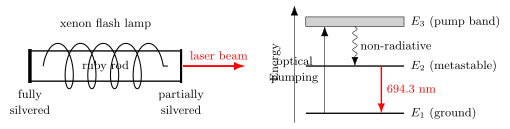
The Ruby laser is a three-level solid-state laser in which optical pumping by a flash lamp creates population inversion at a metastable energy level of Cr ions, and stimulated emission between mirrored ends of the ruby rod produces a coherent 694.3 nm beam.
Construction
The active medium is a ruby rod — a cylindrical crystal of aluminium oxide (AlO, corundum) in which a small fraction (about ) of the Al ions are replaced by chromium ions Cr; it is the Cr ions that provide the laser transition. The rod's two end faces are ground flat, polished, and made exactly parallel to each other, forming an optical resonant cavity:
- One end is fully silvered (essentially 100% reflecting).
- The other end is partially silvered (partially transmitting), through which the output laser beam eventually emerges.
The ruby rod is surrounded by a helical (coil-shaped) xenon flash lamp, which wraps around the rod and provides the intense burst of light (rich in green/blue wavelengths around 5500 Angstrom) needed to optically pump the Cr ions. The rod-and-lamp assembly is usually enclosed in a reflecting cavity (an elliptical or cylindrical reflector) so that as much of the flash lamp's light as possible is directed onto the rod, improving pumping efficiency. Since a large fraction of the pump energy is converted to heat, the assembly may be cooled (e.g. by circulating water, or by operating at low temperature) to prevent damage and maintain rod properties.
Energy level diagram (described)
The Cr ion has three energy levels relevant to laser action:
- — the ground state.
- — a broad, higher pump band, which the ions are excited to when they absorb pump-light photons; this level is short-lived (lifetime ), so ions do not stay here.
- — a metastable state, lying below but above ; unusually, this level has a comparatively long lifetime (, i.e. milliseconds — far longer than typical excited-state lifetimes).
The laser transition takes place between and , emitting light of wavelength (deep red).
Working (population inversion, pumping, metastable state, stimulated emission)
- Optical pumping: The flash lamp emits an intense burst of light. Photons of the pump wavelengths are absorbed by ground-state Cr ions, raising them from to the pump band .
- Fast non-radiative decay: Because is short-lived, ions excited to almost immediately lose part of their energy to the crystal lattice (as heat/phonons) and drop down to the metastable state , without emitting light.
- Population inversion: Since is metastable (long-lived), ions accumulate there far faster than they decay back to . With sufficiently intense, continued pumping, the population of ions in exceeds the population remaining in — a population inversion between and , the essential condition for laser action. …
Unlock everything free for 14 days
- Full step-by-step solutions
- Concept-first explanations
- Methods, shortcuts & mistakes
- PYQ mapping + timed mock tests
Full access for 14 days. No credit card required.